US influence in Latin America wanes
By FRANK BAJAK – Oct 11, 2008 World Trade Magazine
QUITO, Ecuador (AP) — In a matter of weeks, a Russian naval squadron will arrive in the waters off Latin America for the first time since the Cold War. It is already getting a warm welcome from some in a region where the influence of the United States is in decline.
"The U.S. Fourth Fleet can come to Latin America but a Russian fleet can't?" said Ecuador's president, Rafael Correa. "If you ask me, any country and any fleet that wants can visit us. We're a country of open doors."
The United States remains the strongest outside power in Latin America by most measures, including trade, military cooperation and the sheer size of its embassies. Yet U.S. clout in what it once considered its backyard has sunk to perhaps the lowest point in decades. As Washington turned its attention to the Middle East, Latin America swung to the left and other powers moved in.
The United States' financial crisis is not helping. Latin American countries forced by Washington to swallow painful austerity measures in the 1980s and 1990s are aghast at the U.S. failure to police its own markets.
"We did our homework — and they didn't, they who've been telling us for three decades what to do," the man who presides over Latin America's largest economy, President Luiz Inacio Lula de Silva of Brazil, complained bitterly.
Latin America's more than 550 million people now "have every reason to view the U.S. as a banana republic," says analyst Michael Shifter of the Inter-American Dialogue think tank in Washington. "U.S. lectures to Latin Americans about excess greed and lack of accountability have long rung hollow, but today they sound even more ridiculous."
From 2002 through 2007, the U.S. image eroded in all six Latin American countries polled by the Pew organization, especially in Venezuela, Argentina and Bolivia. (The others were Brazil, Peru and Mexico.) People surveyed in 18 Latin American countries rated President Bush among the least popular leaders in 2007, along with President Hugo Chavez of Venezuela and just ahead of basement-bound Fidel Castro of Cuba, according to the Latinobarometro group of Chile.
In three years of presidential elections ending last year, Latin Americans chose mostly leftist leaders, and only Colombia and El Salvador elected unalloyed pro-U.S. chief executives. In May, the prestigious U.S. Council on Foreign Relations declared the era of U.S. hegemony in the Americas over. And in September, Bolivia and Venezuela both expelled their U.S. ambassadors, accusing them of meddling.
Along with the loss in political standing has come a decline in economic power. U.S. direct investment in Latin America slid from 30 percent to 20 percent of the total from 1998 to 2007, according to the U.N. Economic Commission on Latin American and the Caribbean.
The U.S. still does $560 billion in trade with Latin America, but in the meantime other countries are muscling in. China's trade with Latin America jumped from $10 billion in 2000 to $102.6 billion last year. In May, a state-owned Chinese company agreed to buy a Peruvian copper mine for $2.1 billion.
Other countries are also biting into U.S. military sales in the region. Boeing Co. is vying with finalists from France and Sweden for the sale of 36 jet fighters to Brazil. Venezuela's Chavez has committed to buying more than $4 billion in Russian arms, from Sukhoi jet fighters to Kalashnikov assault rifles. In April, Brazil and Russia agreed to jointly design top-line jet fighters and satellite-launch vehicles, and Brazil is getting technology from France to build a submarine.
"Similar deals could have been made with the United States had it been willing to share its technology," said Geraldo Cavagnari, of the University of Campinas near Sao Paulo.
Last month, Russian Prime Minister Vladimir Putin offered to help Chavez develop nuclear power. Even Colombia, the staunchest U.S. ally in South America, isn't limiting its options. After expressing alarm about the Russian warships a week ago, its defense minister, Juan Manuel Santos, promptly headed for Russia himself to discuss "better relations in defense." Chavez says he expects to hold joint Russian-Venezuelan naval exercises as early as November.
Bolivia also is looking to deepen ties with Russia and Iran.
Although the Islamic republic's ambassador has yet to arrive in South America's poorest country, its top diplomat there announced Friday that Iran will open two low-cost public health clinics.
And while Bolivia's only announced Russian hardware purchase is five helicopters for civil defense, Moscow's ambassador told the AP — after Bolivia booted the U.S. ambassador — that Russia has every right to help Latin American nations arm themselves.
"We know of many historical cases of U.S. intervention in Latin American countries," said the diplomat, Leonid Golubev.
Thomas Shannon, U.S. assistant secretary of state for the hemisphere, wouldn't comment directly on whether the U.S. has lost influence in Latin America. But he added that there is no doubt that the U.S. still holds most of the military power in the Caribbean, and said it has no interest in reviving "Cold War rhetoric." Shannon also noted that overall U.S. aid to the region will reach $2.2 billion for 2009, to total more than $14 billion during Bush's presidency.
However, critics point out that roughly half that aid is for the military or counternarcotics, and that Washington sends more money annually to Israel alone. Even U.S. giving has been dwarfed by Chavez's checkbook diplomacy, which easily eclipses U.S. aid between outright gifts and discounted oil.
His largesse has lured several longtime U.S. friends. Honduras' president, Manuel Zelaya, said last month that after pleading with Washington and the World Bank, he accepted $300 million a year from Chavez for agricultural investment to help fight rising food prices.
"Allies, friends, did not help me when I asked," he said.
Costa Rica's president, Oscar Arias, says Venezuela offers Latin America about four or five times as much money as the United States. Costa Rica has become the 19th member of Petrocaribe, through which Chavez sells Caribbean and Central American nations cut-rate oil at very low interest.
The diminished profile of the U.S. in Latin America comes after a history of welcomed influence dating back to President Franklin Roosevelt's "Good Neighbor" policy of the 1930s, which emphasized cooperation and trade over military intervention. There have been major bailouts, such as Washington's $20 billion rescue of Mexico in the 1994 peso devaluation crisis. As former Assistant Secretary of State Otto Reich noted, "We are the assistance bureau of first choice for the region."
But the U.S. has an ugly legacy of covert intervention in countries including Chile, Nicaragua, Guatemala and Cuba. Chile's center-left president, Michele Bachelet, was jailed and tortured by a U.S.-backed military dictatorship in the 1970s. She recently recalled telling Washington's ambassador to Chile an old joke: "Some say the only reason there's never been a coup in the United States is because there's no U.S. Embassy in the United States."
The United States has also long served as chief educator to Latin America's elite. Correa is among its presidents with a U.S. graduate degree — though that didn't stop him from accusing the CIA of infiltrating his military, or refusing to renew a lease for U.S. counterdrug missions to fly out of Ecuador.
With the U.S. facing its own financial crisis, it's unlikely to be able to leverage economic influence in Latin America anytime soon. Sen. Barack Obama's senior adviser on Latin America, Dan Restrepo, acknowledges that his candidate is essentially proposing a symbolic shift in style — albeit adding a special White House envoy for the Americas.
"Barack doesn't see the United States as the savior of the Americas, but as a constructive partner," Restrepo told the AP.
Reich, an adviser to Sen. John McCain who served three Republican presidents in the region, put it even more bluntly.
"No matter who is elected in November, there is not going to be any money for Latin America," he said. "Latin Americans expecting financial resources, any kind of help from the United States, they are barking up the wrong tree."
Associated Press writers Dan Keane in Bolivia, Eduardo Gallardo in Chile and Stan Lehman in Brazil contributed to this report.
Monday, October 20, 2008


Friday, October 10, 2008
** Basic Knowledge Required for Trading in Natural Resources
- Do You Understand the Flow of the Transactions and the Abbreviations? -
Mr. Tatsuya Oishi, President, Focus Business Produce, Inc.. with the Japan External Trade Organization
The TTPP Newsletter of September 2008 reported the frequent occurrence of trouble in transactions involving recycled materials, metal materials and other resources through the TTPP. To help keep you out of trouble over resource transactions and avoid unnecessary risks, I will explain the general flow of transactions in the resource trade and the main abbreviations used at that time.
International transactions in metal/mineral resources and food resources are characterized by the following three points: First, the sums involved are huge. For example, in term contracts (long term contracts continuing for a fixed period such as several months), sums of tens to hundreds of millions of yen are often seen. Second, specialized brokers or agents often act as intermediaries. Third, due to the large volumes, at the time of FOB contracts, space in specialized ships is sometimes arranged.
Resource transactions used to be generally conducted by specialized businesses.
In recent years, due to the increase in demand, easing of regulations, establishment of infrastructure and spread of the Internet, the environment is being laid enabling more traders to participate in resource transactions.
Along with the increased opportunities, beginners in the resource trade are exposed to greater risk of scams and other dangers.
Therefore, both the seller and the buyer have to reduce the risks by exercising greater caution in procedures compared with general container-based transactions. Seen from another perspective, it means that the seller determines how reliable the buyer is based on the buyer's familiarity with the complicated procedures of the resource trade. Let us introduce an example of the flow of a resource transaction.
[1] Buyer : Sends an LOI and BCL.
[2] Seller: Sends an FCO.
[3] Buyer : Signs the FCO and returns it to the Seller.
[4] Seller: Sends a draft contract to the Buyer.
[5] Buyer : Signs the draft contract and returns it to the Seller.
[6] Buyer : Requests a POP from the Seller.
[7] Buyer : Opens an SBLC or BG.
[8] Seller: Sets a PB.
[9] Seller: Loads and ships the product in accordance with the contract terms.
(Sometimes allows Buyer to witness shipment.) [10] Buyer: Sends payment in accordance with the contract terms.
The hardest things for beginners to understand are abbreviated terms such as LOI, BCL and FCO. Let us explain them next.
1) LOI = Letter of Intent This is a letter by which the Buyer expresses its intent to buy the product. It describes the name of the product, the product specifications and country of origin, quantity, term of the purchasing contract, desired price, terms of transaction (FOB, CFR, CIF, etc.), desired shipment date, method of payment and valid period of LOI.
On the other hand, the Seller's side will sometimes ask for disclosure of the Buyer's bank's name, bank account number, etc. and for its understanding of a "soft probe" so as to investigate the Buyer's ability to pay. A "soft probe"
means the procedure of contacting the Buyer's bank through the Seller's bank to briefly investigate the Buyer's ability to pay.
2) BCL=Bank Comfort Letter (Bank Capability Letter) This is a letter issued by the Buyer's bank to the Seller and certifies that the Buyer has sufficient ability to pay for the transaction in question. The BCL may be demanded by the Seller at the stage of the LOI, the time of signing the contract, etc. Several cases are possible.
3) FCO=Firm Corporate Offer (Full Corporate Offer) This is a formal offer by which the Seller proposes details of the transaction and the final price. If the Buyer accepts these terms, it signs the offer and returns it to the Seller. Next, the Seller sends a draft of the contract.
Depending on the transaction, the two parties will sometimes enter negotiations on concluding the contract directly without going through the FCO process.
4) POP=Proof of Product In the same way as the Seller thinks the Buyer's ability to pay is important, the Buyer finds it important to determine if the Seller really owns the products in question or has the right to deal in them. A document proving the ownership or right of trade of the product is called a "POP".
Specifically, this includes an export license issued by an official organization, a warehouse receipt and certification of results of inspection by an independent third party certification organization. However, it is essential to determine if the documents are genuine.
Further, as a method to ensure a more reliable progress in the process, sometimes a POF (Proof of Funds/document proving the Buyer's ability to pay) and POP are exchanged between the Seller's and the Buyer's banks.
5) BG=Bank Guarantee, SBLC=Stand By Letter of Credit, PB=Performance Bond
- A BG is, as the name implies, a bank guarantee. The bank guarantees that the Buyer will pay the debt to the Seller.
- An SBLC differs from a usual L/C (Letter of Credit) in that it is a special letter of credit with no terms requiring attachment of a bill of lading (type of clean letter of credit) and is considered a bank guarantee issued in the form of a letter of credit.
- In the event the Buyer defaults on its debt, in both a BG or SBLC, the issuing bank guarantees payment to the Seller.
- A PB is a proof of performance. It guarantees payment to the Buyer of a fixed percentage of the export price (for example, 2%) in the event of the Seller defaulting on the contract to export to the Buyer as contracted for. Due to this, if the Seller defaults on the contract, the Buyer can be compensated for the expenses required up to that point. Specifically, this is set by the
Seller for the Buyer in the form of a BG or SBLC.
There may be various other variations in the flow of transactions. Further, technical terms and other specialized terminology unique to the industry/ resource will also be used. Therefore, the most important point in resource transactions is sufficient understanding of the products. Can you completely understand the processes involved in a transaction proposed by a seller and do you really have a grasp over the potential risks behind the transaction? If you find this difficult, I recommend you should not let yourself get involved in such a transaction or you leave it to experts such as specialized trading companies.
Above, I explained part of the basic knowledge required for resource transactions. In actual transactions, be sure to check by yourself the flow of transactions and terminology unique to the individual industry and remember that only you are responsible for the transaction.
===============================================================================
*******************************************************************************
TTPP News Back Numbers
http://www3.jetro.go.jp/ttppoas/mailnews/index.html
*******************************************************************************
- Do You Understand the Flow of the Transactions and the Abbreviations? -
Mr. Tatsuya Oishi, President, Focus Business Produce, Inc.. with the Japan External Trade Organization
The TTPP Newsletter of September 2008 reported the frequent occurrence of trouble in transactions involving recycled materials, metal materials and other resources through the TTPP. To help keep you out of trouble over resource transactions and avoid unnecessary risks, I will explain the general flow of transactions in the resource trade and the main abbreviations used at that time.
International transactions in metal/mineral resources and food resources are characterized by the following three points: First, the sums involved are huge. For example, in term contracts (long term contracts continuing for a fixed period such as several months), sums of tens to hundreds of millions of yen are often seen. Second, specialized brokers or agents often act as intermediaries. Third, due to the large volumes, at the time of FOB contracts, space in specialized ships is sometimes arranged.
Resource transactions used to be generally conducted by specialized businesses.
In recent years, due to the increase in demand, easing of regulations, establishment of infrastructure and spread of the Internet, the environment is being laid enabling more traders to participate in resource transactions.
Along with the increased opportunities, beginners in the resource trade are exposed to greater risk of scams and other dangers.
Therefore, both the seller and the buyer have to reduce the risks by exercising greater caution in procedures compared with general container-based transactions. Seen from another perspective, it means that the seller determines how reliable the buyer is based on the buyer's familiarity with the complicated procedures of the resource trade. Let us introduce an example of the flow of a resource transaction.
[2] Seller: Sends an FCO.
[3] Buyer : Signs the FCO and returns it to the Seller.
[4] Seller: Sends a draft contract to the Buyer.
[5] Buyer : Signs the draft contract and returns it to the Seller.
[6] Buyer : Requests a POP from the Seller.
[7] Buyer : Opens an SBLC or BG.
[8] Seller: Sets a PB.
[9] Seller: Loads and ships the product in accordance with the contract terms.
(Sometimes allows Buyer to witness shipment.) [10] Buyer: Sends payment in accordance with the contract terms.
The hardest things for beginners to understand are abbreviated terms such as LOI, BCL and FCO. Let us explain them next.
1) LOI = Letter of Intent This is a letter by which the Buyer expresses its intent to buy the product. It describes the name of the product, the product specifications and country of origin, quantity, term of the purchasing contract, desired price, terms of transaction (FOB, CFR, CIF, etc.), desired shipment date, method of payment and valid period of LOI.
On the other hand, the Seller's side will sometimes ask for disclosure of the Buyer's bank's name, bank account number, etc. and for its understanding of a "soft probe" so as to investigate the Buyer's ability to pay. A "soft probe"
means the procedure of contacting the Buyer's bank through the Seller's bank to briefly investigate the Buyer's ability to pay.
2) BCL=Bank Comfort Letter (Bank Capability Letter) This is a letter issued by the Buyer's bank to the Seller and certifies that the Buyer has sufficient ability to pay for the transaction in question. The BCL may be demanded by the Seller at the stage of the LOI, the time of signing the contract, etc. Several cases are possible.
3) FCO=Firm Corporate Offer (Full Corporate Offer) This is a formal offer by which the Seller proposes details of the transaction and the final price. If the Buyer accepts these terms, it signs the offer and returns it to the Seller. Next, the Seller sends a draft of the contract.
Depending on the transaction, the two parties will sometimes enter negotiations on concluding the contract directly without going through the FCO process.
4) POP=Proof of Product In the same way as the Seller thinks the Buyer's ability to pay is important, the Buyer finds it important to determine if the Seller really owns the products in question or has the right to deal in them. A document proving the ownership or right of trade of the product is called a "POP".
Specifically, this includes an export license issued by an official organization, a warehouse receipt and certification of results of inspection by an independent third party certification organization. However, it is essential to determine if the documents are genuine.
Further, as a method to ensure a more reliable progress in the process, sometimes a POF (Proof of Funds/document proving the Buyer's ability to pay) and POP are exchanged between the Seller's and the Buyer's banks.
5) BG=Bank Guarantee, SBLC=Stand By Letter of Credit, PB=Performance Bond
- A BG is, as the name implies, a bank guarantee. The bank guarantees that the Buyer will pay the debt to the Seller.
- An SBLC differs from a usual L/C (Letter of Credit) in that it is a special letter of credit with no terms requiring attachment of a bill of lading (type of clean letter of credit) and is considered a bank guarantee issued in the form of a letter of credit.
- In the event the Buyer defaults on its debt, in both a BG or SBLC, the issuing bank guarantees payment to the Seller.
- A PB is a proof of performance. It guarantees payment to the Buyer of a fixed percentage of the export price (for example, 2%) in the event of the Seller defaulting on the contract to export to the Buyer as contracted for. Due to this, if the Seller defaults on the contract, the Buyer can be compensated for the expenses required up to that point. Specifically, this is set by the
Seller for the Buyer in the form of a BG or SBLC.
Above, I explained part of the basic knowledge required for resource transactions. In actual transactions, be sure to check by yourself the flow of transactions and terminology unique to the individual industry and remember that only you are responsible for the transaction.
===============================================================================
*******************************************************************************
TTPP News Back Numbers
http://www3.jetro.go.jp/ttppoas/mailnews/index.html
*******************************************************************************
Tuesday, October 07, 2008
Managing Your Customs Brokers
by Ruth Rodriguez, Attorney
If you are an importer, you probably rely heavily on customs brokers. You may not have the inclination or the resources to clear your own entries. Customs brokers can be indispensable for classification and other compliance areas. Some brokers also provide other services, including logistics and shipping. Brokers are highly trained professionals, having been vetted and licensed by US Customs and Border Protection (CBP). Using customs brokers (or other professionals, like customs attorneys) can help convince enforcement authorities that you are using reasonable care. Customs brokerage has existed as a profession for centuries, preceding the founding of our nation and proving itself essential to international commerce.
But none of this means that you give your customs broker carte blanche. A customs broker is your agent. When the customs broker makes a mistake, it is your mistake. When the customs broker violates the law, the law presumes that the customs broker is acting at your company's behest.
Hiring a customs broker does not insulate you from liability. It only extends the avenues for enforcement officials to tag your company for errors and violations. If errors and violations are uncovered, the importer-broker relationship may turn adversarial, with one party blaming the other. Some customs brokers feel that they owe a greater allegiance to CBP than to the importer. In the end, if you chose the wrong broker, you (not your broker) can lose out on the duty-free savings from programs that you did not know about, you are likely to pay hundreds of thousands, or even millions of dollars, in fines and penalties, and you are likely to pay similar amounts in administrative costs and fees to resolve the violations.
Thus, a hands-off approach is calamitous. You must remain actively involved with everything your customs broker does on your behalf. The best way to do this is to limit the number of brokers you hire, restrict the terms and duration of the powers of attorney you grant, create Standard Operating Procedures (SOPs) for your brokers, and supervise and audit broker performance.
Limit the Number of Customs Brokers. Use a customs broker as liberally as you need to, but limit the number of brokerage firms you hire. Having too many brokers is a sign that you do not control your brokers.If you do not know how many brokers you are using or who they are, you may be in even bigger trouble. There are ways, with the help of an attorney, to find out who is making entries on your company's behalf.Once you know who your customs brokers are, trim them to a manageable number. Find out what each broker is doing on your company's behalf. You may discover that you are paying more than one broker to do the same task. You may also find a disparity in the fees you pay different brokerage firms. You may find out that there are individuals and departments within your company that hire customs brokers when they have no authority to do so. All this information will enable you to negotiate for better terms with the brokers you do retain, and to create company policies limiting who can hire brokers.With all this information in hand, start revoking the powers of attorney of customs brokers that you do not need.
Sign Better Powers of Attorney. Revisit the contracts and powers of attorney for those brokers you intend to retain. It is tempting to sign the "industry standard" power of attorney or contract, but the terms and conditions may not serve your company well. There may be exculpatory clauses, limitations of damages, and other language that is suspect. Many importers sign unlimited powers of attorney. That is a big mistake. This is your power of attorney. You are the principal. You decide what the customs broker can and cannot do when representing you. Also consider limiting the duration of your powers of attorney. Avoiding "standard" forms will benefit both parties. It will force you into a dialogue with your broker, and the expectations of both parties will be revealed with clarity and reduced to writing.
Create Standard Operating Procedures (SOPs) for your customs brokers to follow. Make sure that your brokers are contractually obligated to follow your SOPs. How much, if at all, you involve your broker in developing your SOPs is a matter of choice and comfort level.
Audit your customs brokers for compliance with your SOPs. No one in your company should ever say anything like, "We don't worry about that (e.g., classification). That's what we have a broker for." There are many ways to audit your customs brokers, and your review does not have to be incredibly intrusive or prolonged. But in the end, be brutally honest in grading your customs brokers. Your customs brokers should certainly not be reluctant to cooperate, having agreed to your SOPs.
Get a good lawyer Hire a seasoned lawyer to help your company foster a mutually beneficial relationship with your customs brokers, someone who is responsible primarily for protecting your company's interests.
---------------------GRVR Attorneys has represented both customs brokers and importers for two decades. Several of our attorneys have also passed the customs broker exam and have worked in logistics and transportation.
by Ruth Rodriguez, Attorney
If you are an importer, you probably rely heavily on customs brokers. You may not have the inclination or the resources to clear your own entries. Customs brokers can be indispensable for classification and other compliance areas. Some brokers also provide other services, including logistics and shipping. Brokers are highly trained professionals, having been vetted and licensed by US Customs and Border Protection (CBP). Using customs brokers (or other professionals, like customs attorneys) can help convince enforcement authorities that you are using reasonable care. Customs brokerage has existed as a profession for centuries, preceding the founding of our nation and proving itself essential to international commerce.
But none of this means that you give your customs broker carte blanche. A customs broker is your agent. When the customs broker makes a mistake, it is your mistake. When the customs broker violates the law, the law presumes that the customs broker is acting at your company's behest.
Hiring a customs broker does not insulate you from liability. It only extends the avenues for enforcement officials to tag your company for errors and violations. If errors and violations are uncovered, the importer-broker relationship may turn adversarial, with one party blaming the other. Some customs brokers feel that they owe a greater allegiance to CBP than to the importer. In the end, if you chose the wrong broker, you (not your broker) can lose out on the duty-free savings from programs that you did not know about, you are likely to pay hundreds of thousands, or even millions of dollars, in fines and penalties, and you are likely to pay similar amounts in administrative costs and fees to resolve the violations.
Thus, a hands-off approach is calamitous. You must remain actively involved with everything your customs broker does on your behalf. The best way to do this is to limit the number of brokers you hire, restrict the terms and duration of the powers of attorney you grant, create Standard Operating Procedures (SOPs) for your brokers, and supervise and audit broker performance.
Limit the Number of Customs Brokers. Use a customs broker as liberally as you need to, but limit the number of brokerage firms you hire. Having too many brokers is a sign that you do not control your brokers.If you do not know how many brokers you are using or who they are, you may be in even bigger trouble. There are ways, with the help of an attorney, to find out who is making entries on your company's behalf.Once you know who your customs brokers are, trim them to a manageable number. Find out what each broker is doing on your company's behalf. You may discover that you are paying more than one broker to do the same task. You may also find a disparity in the fees you pay different brokerage firms. You may find out that there are individuals and departments within your company that hire customs brokers when they have no authority to do so. All this information will enable you to negotiate for better terms with the brokers you do retain, and to create company policies limiting who can hire brokers.With all this information in hand, start revoking the powers of attorney of customs brokers that you do not need.
Sign Better Powers of Attorney. Revisit the contracts and powers of attorney for those brokers you intend to retain. It is tempting to sign the "industry standard" power of attorney or contract, but the terms and conditions may not serve your company well. There may be exculpatory clauses, limitations of damages, and other language that is suspect. Many importers sign unlimited powers of attorney. That is a big mistake. This is your power of attorney. You are the principal. You decide what the customs broker can and cannot do when representing you. Also consider limiting the duration of your powers of attorney. Avoiding "standard" forms will benefit both parties. It will force you into a dialogue with your broker, and the expectations of both parties will be revealed with clarity and reduced to writing.
Create Standard Operating Procedures (SOPs) for your customs brokers to follow. Make sure that your brokers are contractually obligated to follow your SOPs. How much, if at all, you involve your broker in developing your SOPs is a matter of choice and comfort level.
Audit your customs brokers for compliance with your SOPs. No one in your company should ever say anything like, "We don't worry about that (e.g., classification). That's what we have a broker for." There are many ways to audit your customs brokers, and your review does not have to be incredibly intrusive or prolonged. But in the end, be brutally honest in grading your customs brokers. Your customs brokers should certainly not be reluctant to cooperate, having agreed to your SOPs.
Get a good lawyer Hire a seasoned lawyer to help your company foster a mutually beneficial relationship with your customs brokers, someone who is responsible primarily for protecting your company's interests.
---------------------GRVR Attorneys has represented both customs brokers and importers for two decades. Several of our attorneys have also passed the customs broker exam and have worked in logistics and transportation.
Monday, October 06, 2008
Understanding and Complying with the New Foreign Trade Regulation (FTR) Requirements:
Starting October 1, 2008, the Census Bureau will require mandatory filing of export information through the Automated Export System (AES) or through AESDirect for all shipments where a paper Shipper’s Export Declaration is required. Penalties may be imposed for the delayed filing, failure to file, false filing of export information, and/or using the AES to further any illegal activity. Also, all AES filers will face new filing deadlines by mode of transportation for reporting export information. For more information, visit www.census.gov/foreign-trade/aes.
It is imperative you understand these new requirements to avoid possible penalties and seizure of your commodities. To this end, the U.S. Census Bureau’s Foreign Trade Division and the U.S. Commercial Service are offering a series of webinars designed to educate U.S. exporters on these new regulations. Webinar topics will be divided into five modules:
Data Elements covers the mandatory, conditional and optional fields in AES.
Filing Requirements covers who, what, when, and how to file export transactions.
Parties to an Export Transaction & Their Responsibilities covers each party’s responsibility as it relates to a standard export and routed export transactions.
AES Overview provides highlights of the AES.
Informed & Enforced Compliance covers topics such as penalties, mitigation, voluntary self-disclosure and corrections. Register at www.export.gov/logistics/aes/doc_eg_aes.asp
Starting October 1, 2008, the Census Bureau will require mandatory filing of export information through the Automated Export System (AES) or through AESDirect for all shipments where a paper Shipper’s Export Declaration is required. Penalties may be imposed for the delayed filing, failure to file, false filing of export information, and/or using the AES to further any illegal activity. Also, all AES filers will face new filing deadlines by mode of transportation for reporting export information. For more information, visit www.census.gov/foreign-trade/aes.
It is imperative you understand these new requirements to avoid possible penalties and seizure of your commodities. To this end, the U.S. Census Bureau’s Foreign Trade Division and the U.S. Commercial Service are offering a series of webinars designed to educate U.S. exporters on these new regulations. Webinar topics will be divided into five modules:
Data Elements covers the mandatory, conditional and optional fields in AES.
Filing Requirements covers who, what, when, and how to file export transactions.
Parties to an Export Transaction & Their Responsibilities covers each party’s responsibility as it relates to a standard export and routed export transactions.
AES Overview provides highlights of the AES.
Informed & Enforced Compliance covers topics such as penalties, mitigation, voluntary self-disclosure and corrections. Register at www.export.gov/logistics/aes/doc_eg_aes.asp
Friday, October 03, 2008
AN UNTAPPED MARKET
September 8, 2008 J. JOSEPH GRANDMAISON Shipping Digest Online
September 8, 2008 J. JOSEPH GRANDMAISON Shipping Digest Online
Most Americans reading this column probably aren’t doing business in Africa. That is a shame because export opportunities in Africa are real and growing, and U.S. companies ought to be entering these markets now as African countries are developing their infrastructure and industries.
Over the years that I have served as a board member of the Export-Import Bank of the United States and have spoken with government and business leaders from all over Africa, it has become clear to me that too few U.S. companies are marketing in Africa. African contracts are often awarded to competitors from other countries at least in part because no U.S. companies have bid on them. That is unfortunate because Americans have a reputation for providing superior quality and for upholding their contracts. African project sponsors and other buyers are favorably disposed to U.S. companies – when there are some.
Here are the facts: The African continent is growing economically because of political stability and economic reforms in many countries. In 2006, the economy of all of sub-Saharan Africa increased 5.5 percent. In fact, 23 African countries expanded at a rate faster than 5 percent, and only Zimbabwe failed to grow.
Since the inception of the African Growth and Opportunity Act, U.S. trade with sub-Saharan Africa has increased from $29 billion in 2000 to more than $71 billion last year. AGOA provides beneficiary countries in sub-Saharan Africa with liberal access to the U.S. market and also contributes to better market opportunities for U.S. companies. In 2007, U.S. exports to sub-Saharan Africa totaled $14.4 billion, which is more than double the amount in 2001. Today 40 sub-Saharan African countries are eligible for AGOA benefits. AGOA is fostering an improved business climate in Africa and expanded U.S.-African trade.
Africa’s strong economic growth is producing a rising demand for equipment and services, as well as consumer products. Some of the sectors with substantial potential include oil field development, electric power generation, transportation, health care, telecommunications, computers and software.
Ex-Im Bank, the official export-credit agency of the U.S., has a congressional mandate to assist U.S. exports to sub-Saharan Africa, and we have increased our financing for these exports. We have seen a shift in demand for our products from short-term export-credit insurance (typically used for raw materials, spare parts and consumer products) to medium-term credit and long-term project and structured finance (typically used for capital goods and services).
In fiscal 2007, Ex-Im Bank authorized $442 million in transactions to 18 sub-Saharan African countries. Much of this financing assisted Boeing’s exports to African airlines, but it also supported exports of U.S. equipment and technology to African oil field and oil-storage projects, manufacturing and fishing companies, among others.
One market serving as a model for Ex-Im Bank financing in Africa is Nigeria. With oil sector revenue and the reform of its banking sector in 2006, Nigeria’s economy is growing considerably. Development of the power and transportation sectors, including ports, roads and airports, is particularly urgent.
To help U.S. exporters in Nigeria, Ex-Im Bank established a special delegated authority facility that now includes 14 Nigerian banks. This facility is making $1 billion in financing available for Nigerian buyers of U.S. goods and services.
The Nigerian model has been emulated with Ex-Im Bank’s new special delegated authority for the African Export-Import Bank, which can now provide up to $40 million in Ex-Im Bank-backed short-term and midterm financing. This facility serves as a marketing tool to promote the purchase of U.S. goods and services virtually throughout the continent.
Earlier this year, Ex-Im Bank also opened for medium-term financing in the public and private sectors in Angola, where opportunities in the oil, gas and mining sectors are enormous. We want more U.S. exporters to take advantage of these developments.
We advise companies to focus on markets where opportunities for their sectors are greatest. The U.S. Foreign and Commercial Service, www.export.gov/africa, is an excellent resource, and its Country Commercial Guides are invaluable. We also recommend participation in the Corporate Council on Africa’s 2008 U.S.-Africa Infrastructure Conference in Washington, D.C., on Oct. 6-8, 2008, http://www.africancl.org/.
Lastly, we invite those U.S. exporters seeking financing for their African contracts to contact Ex-Im Bank, www.exim.gov/products/special/africa. We can do more for U.S. exporters in Africa. We’ll help you realize the opportunities in this vast untapped market.
J. Joseph Grandmaison is a board member of the Export-Import Bank of the United States.
Wednesday, October 01, 2008
Wood Importers' Alert -- New Declaration Requirement
GRVR Attorneys - Oct Newsletter
The latest Farm Bill imposes new requirements on wood importers, a group that may be much larger than you might think. Importers of plants and plant products are now required to certify that their products do not come from illegally harvested trees or plants. Specifically, importers must file a declaration regarding the species and country of origin. The world's forests are being cut down illegally to supply the US domestic market. (See, for example, Brazil's government has been named as the worst illegal logger of Amazon forests by one of its own departments). US wood and furniture manufacturers, environmental groups, and labor unions inserted into the Farm Bill an amendment to the Lacey Act, our country's oldest wildlife protection statute.
Customs and Border Protection and the Agriculture Department's Animal Plant Health Inspection Service (APHIS) will enforce the new law. Importers must start filing declarations by December 15, 2008, unless federal regulators and industry representatives can negotiate an extension or a tiered phase-in, which appears likely. Flooring, furniture, paperboard and plywood are clearly covered, but the new law may cover importers of many other products containing wood or plant material. The law does not specify how importers should certify their products, but it is clear that violators face huge penalties and the danger of shipment seizure.
GRVR Attorneys - Oct Newsletter
The latest Farm Bill imposes new requirements on wood importers, a group that may be much larger than you might think. Importers of plants and plant products are now required to certify that their products do not come from illegally harvested trees or plants. Specifically, importers must file a declaration regarding the species and country of origin. The world's forests are being cut down illegally to supply the US domestic market. (See, for example, Brazil's government has been named as the worst illegal logger of Amazon forests by one of its own departments). US wood and furniture manufacturers, environmental groups, and labor unions inserted into the Farm Bill an amendment to the Lacey Act, our country's oldest wildlife protection statute.
Customs and Border Protection and the Agriculture Department's Animal Plant Health Inspection Service (APHIS) will enforce the new law. Importers must start filing declarations by December 15, 2008, unless federal regulators and industry representatives can negotiate an extension or a tiered phase-in, which appears likely. Flooring, furniture, paperboard and plywood are clearly covered, but the new law may cover importers of many other products containing wood or plant material. The law does not specify how importers should certify their products, but it is clear that violators face huge penalties and the danger of shipment seizure.
Tuesday, September 30, 2008
MANUFACTURED GOODS EXPORTS UP
September 22, 2008 Shipping Digest Online
U.S. exports of manufactured goods in July were up 22 percent over July 2007, bringing the total for the first seven months of the year to $669 billion, a 16 percent increase over the same period last year, according to Frank Vargo, vice president for international economic affairs at the National Association of Manufacturers.
Manufactured imports rose 8 percent in July and are up 7 percent for the year. The $933 billion import tab resulted in a $264 billion deficit, 15 percent lower than in the first seven months of 2007.
The surplus with U.S. partners in the North American Free Trade Agreement and other free-trade partners totaled $8.1 billion in the first seven months of the year, for an annual rate of $14 billion, Vargo said.
“Many people have been led to believe we have a terrible trade position with our FTA partners and are unaware that our manufactured goods trade with them is in surplus,” Vargo said. “And that’s a shame, because if they knew, they would join the NAM in asking Congress to pass the remaining FTAs so we could have our exports increase even more. The lesson is clear – free-trade agreements are the solution, not the problem.”
September 22, 2008 Shipping Digest Online
U.S. exports of manufactured goods in July were up 22 percent over July 2007, bringing the total for the first seven months of the year to $669 billion, a 16 percent increase over the same period last year, according to Frank Vargo, vice president for international economic affairs at the National Association of Manufacturers.
Manufactured imports rose 8 percent in July and are up 7 percent for the year. The $933 billion import tab resulted in a $264 billion deficit, 15 percent lower than in the first seven months of 2007.
The surplus with U.S. partners in the North American Free Trade Agreement and other free-trade partners totaled $8.1 billion in the first seven months of the year, for an annual rate of $14 billion, Vargo said.
“Many people have been led to believe we have a terrible trade position with our FTA partners and are unaware that our manufactured goods trade with them is in surplus,” Vargo said. “And that’s a shame, because if they knew, they would join the NAM in asking Congress to pass the remaining FTAs so we could have our exports increase even more. The lesson is clear – free-trade agreements are the solution, not the problem.”
Monday, September 29, 2008
Costa Rica seeks more time – again – on CAFTA
By Gillian Gillers Tico Times Staff ggillers@ticotimes.net
For the second time, Costa Rica is seeking to extend its deadline for entering the Central American Free-Trade Agreement with the United States (CAFTA).
Vice President Laura Chinchilla met with Peter Brennan, the chargé d'affaires at the U.S. Embassy, on Friday to request more time to enter the pact, according to the daily La Nación.
Chinchilla said the country would miss its Oct. 1 deadline after the Supreme Court on Thursday struck down an intellectual property law designed to put Costa Rica in compliance with CAFTA.
“We are convinced – and this is the message that we want to give Costa Ricans – that we will still be able to enter CAFTA,” Chinchilla said at an Thursday night. She then turned to a soccer metaphor: “In the last few minutes of the game, we have been dealt a yellow card. We don't think it's a red card.”
The Constitutional Chamber of the Supreme Court (Sala IV) found that lawmakers had failed to consult indigenous groups when debating the bill, as required under a 1989 United Nations convention. Lawmakers must now fix their error and pass the bill again.
The proposal was the last of 13 bills required for Costa Rica to enter CAFTA, which was ratified in a national referendum last October. After lawmakers missed a Feb. 29 deadline for passing the bills, Costa Rica's trading partners granted the country a seven-month extension.
Chinchilla said the administration will decide how much more time to request once the Sala IV releases its full ruling. The other CAFTA signers – the United States, Guatemala, El Salvador, Honduras, Nicaragua and the Dominican Republic – have all entered the treaty.
By Gillian Gillers Tico Times Staff ggillers@ticotimes.net
For the second time, Costa Rica is seeking to extend its deadline for entering the Central American Free-Trade Agreement with the United States (CAFTA).
Vice President Laura Chinchilla met with Peter Brennan, the chargé d'affaires at the U.S. Embassy, on Friday to request more time to enter the pact, according to the daily La Nación.
Chinchilla said the country would miss its Oct. 1 deadline after the Supreme Court on Thursday struck down an intellectual property law designed to put Costa Rica in compliance with CAFTA.
“We are convinced – and this is the message that we want to give Costa Ricans – that we will still be able to enter CAFTA,” Chinchilla said at an Thursday night. She then turned to a soccer metaphor: “In the last few minutes of the game, we have been dealt a yellow card. We don't think it's a red card.”
The Constitutional Chamber of the Supreme Court (Sala IV) found that lawmakers had failed to consult indigenous groups when debating the bill, as required under a 1989 United Nations convention. Lawmakers must now fix their error and pass the bill again.
The proposal was the last of 13 bills required for Costa Rica to enter CAFTA, which was ratified in a national referendum last October. After lawmakers missed a Feb. 29 deadline for passing the bills, Costa Rica's trading partners granted the country a seven-month extension.
Chinchilla said the administration will decide how much more time to request once the Sala IV releases its full ruling. The other CAFTA signers – the United States, Guatemala, El Salvador, Honduras, Nicaragua and the Dominican Republic – have all entered the treaty.
Tuesday, September 09, 2008
Latin America on Target to set more records
We, at Dixie Cullen, have seen a large increase in the volumne of equipment and material coming through our warehouse facility for export packing bound for Latin America.
TRADE WITH LATIN AMERICA ON TARGET TO SET MORE RECORDS September 1, 2008 LETICIA LOZANO from Shipping Digest
Rapid economic growth spurs demands for U.S. importsSoaring energy and food prices, the worst housing slump since the Great Depression, a credit crisis, job cuts: It all may be enough to tip the U.S. into recession this year, if we aren’t already there. But the “flu” in the world’s biggest economy is causing little more than the sniffles in Latin America, where growth remains strong and a weak dollar is driving trade between the U.S. and South America.
With Latin American banks having little or no exposure to the U.S. credit crunch, and with the region’s strong domestic currencies, a China-driven commodities boom, high foreign investment levels and fiscal discipline, trade is robust — despite soaring oil prices, rising freight costs and Latin America’s congested ports.
“We haven’t seen impact from the U.S. slowdown,” said Alvaro Espinosa, general manager at the Port of San Antonio, Chile, which sends 16 percent of its exports to the U.S. and where U.S. imports represent 25 percent of all imports. “In the first five months of this year, we’ve seen a 15 percent increase in container shipments, so at least at the first reading, there is no talk of a U.S. recession here.”
Such optimism may be dampened in the coming months if the relentless increases in oil prices continue and as U.S. manufacturing activity falls. Consumer spending is weakening now that the fiscal stimulus checks have mostly been spent.
Overall U.S.-South American trade is nevertheless growing at historic levels, with Chile and Peru benefiting from free-trade deals. U.S. exports to Central and South America reached a record $107.5 billion in 2007, and imports hit a record $134.8 billion, according to the U.S. Census Bureau. Those records will probably be smashed this year. U.S. exports in the first six months of the year totaled $66.8 billion, while imports totaled $80 billion.
Despite the slowing U.S. economy and world oil prices, exports to Central and South America in June were a record $12.9 billion, compared with $8.7 billion in June 2007. Imports totaled $15.7 billion, compared with $10.7 billion in June of last year.
Brazil is enjoying a boom time as its middle class swells and the country enjoys an unprecedented stretch of economic growth coupled with low inflation and a strong currency. Foreign investment doubled to $35 billion last year, the economy grew 5.4 percent, and trade with the U.S. totaled $50 billion. The economy is set to grow 4.5 percent this year.
“The stronger buying power of Latin American currencies, particularly the Brazilian real, and the abundance of petro-dollars in Venezuela have generated a significant increase in export liftings compared to a year ago,” said Frank Larkin, senior vice president at Hamburg Sud North America, the U.S. subsidiary of the German shipping line Hamburg Sud.
Soaring economic growth in Argentina, Peru and Venezuela is also spurring demand for U.S. imports in those countries.
Despite the bitter anti-U.S. rhetoric of President Hugo Chavez, Venezuela is increasingly dependent on U.S. imports and, as the government nationalizes large chunks of the economy, its exports beyond oil are few.
“The downside of that shift is the need to continually reposition empty boxes,” Larkin said. “On the export side, the Venezuelan container market, for example, is virtually all inbound, and those boxes, once emptied, must then be repositioned to match up with export opportunities in other markets.”
Changes to customs laws in Brazil and Colombia this year also have made life difficult for shippers. Both countries now require cargo heading for their ports to be documented 48 hours prior to the vessel’s first Brazilian port call. Failure to do so can mean cargo confiscation or denial of berthing.
“These new mandates are very rigid and unfortunately conflict with the realities of modern just-in-time shipping,” Larkin said. “If manifest information is submitted to (Brazil’s) Siscomex Carga and then changes or additions need to be made, fines of $3,000 per incident can be imposed and cargo delivery can be further delayed.”
Such measures have increased costs for shippers having to rehandle and work export documents, Larkin said.
Thursday, August 28, 2008
Supercharging Your Chinese Supply Chain
Managing an efficient supply chain is critical for global success. Whether you are sourcing products from China or managing export operations, Supercharging Your Chinese Supply Chain focuses on the Chinese side of your import/export transaction and will deliver the tools and information you need to successfully manage your supply chain.
Presented by Shawn Levsen, UPS International Account Executive, this session will cover the key players in the Chinese supply chain including how to choose the right service provider, a review of Chinese export regulations and customs procedures and a detailed overview of the flow of goods and documents. This session will help you improve efficiency, lower risk and increase the profitability of your global supply chain.
Join us on Thursday, September 18th at the Plaza Club San Antonio. Register now!
Next Session - Global Marketing: Managing Your Global Distributor
Developing a win-win relationship with your global distributor is critical to successfully expanding into new markets and growing your company's international sales. Managing Your Global Distributor covers all the important factors that you need to consider while selecting and working with an international sales and marketing partner.
Presented by Jacob Nammar, International Sales Executive, this seminar will guide you through the process of choosing the right distributor, creating a solid contract, complying with legal requirements, and establishing the different methods of monitoring your agreement. This session will help you successfully manage your global distributor in a way that will lower risk, improve relationships and increase sales for your company.
Join us on Thursday, October 16th at the Plaza Club San Antonio. Register Now!
Schedule of Events
09.18.08 Supercharging Your Chinese Supply Chain
10.16.08 Global Marketing: Managing Your Global Distributor
11.13.08 Using Letters of Credit in China
01.22.09 Doing Business in Vietnam
02.12.09 Discovering Business Opportunities in Colombia
03.12.09 International Trade & Protecting Your Intellectual Property
04.16.09 Importing Food Products into the U.S.
06.11.09 Doing Business with Korea
For more information, please visit our website at www.texastrade.org
Become a Sponsor!
Registration
www.texastrade.org11:30 am to 1:00 pmIndividual Rate: $25
Seminar Location
Plaza Club San Antonio 100 W Houston St. #2100 San Antonio, TX 78205
For More Information
E-mail: barbara.mooney@utsa.edu Phone: 210.458.2470Web: www.texastrade.org
Presented by Shawn Levsen, UPS International Account Executive, this session will cover the key players in the Chinese supply chain including how to choose the right service provider, a review of Chinese export regulations and customs procedures and a detailed overview of the flow of goods and documents. This session will help you improve efficiency, lower risk and increase the profitability of your global supply chain.
Join us on Thursday, September 18th at the Plaza Club San Antonio. Register now!
Next Session - Global Marketing: Managing Your Global Distributor
Developing a win-win relationship with your global distributor is critical to successfully expanding into new markets and growing your company's international sales. Managing Your Global Distributor covers all the important factors that you need to consider while selecting and working with an international sales and marketing partner.
Presented by Jacob Nammar, International Sales Executive, this seminar will guide you through the process of choosing the right distributor, creating a solid contract, complying with legal requirements, and establishing the different methods of monitoring your agreement. This session will help you successfully manage your global distributor in a way that will lower risk, improve relationships and increase sales for your company.
Join us on Thursday, October 16th at the Plaza Club San Antonio. Register Now!
Schedule of Events
09.18.08 Supercharging Your Chinese Supply Chain
10.16.08 Global Marketing: Managing Your Global Distributor
11.13.08 Using Letters of Credit in China
01.22.09 Doing Business in Vietnam
02.12.09 Discovering Business Opportunities in Colombia
03.12.09 International Trade & Protecting Your Intellectual Property
04.16.09 Importing Food Products into the U.S.
06.11.09 Doing Business with Korea
For more information, please visit our website at www.texastrade.org
Become a Sponsor!
Registration
www.texastrade.org11:30 am to 1:00 pmIndividual Rate: $25
Seminar Location
Plaza Club San Antonio 100 W Houston St. #2100 San Antonio, TX 78205
For More Information
E-mail: barbara.mooney@utsa.edu Phone: 210.458.2470Web: www.texastrade.org
Wednesday, August 27, 2008
Deficit Shrinks as Exports Surge
DEFICIT SHRINKS AS EXPORTS SURGE
August 25, 2008 Shippers Digest
The U.S. trade deficit dropped 4.1 percent in June despite soaring prices for imported oil. Goods exports increased 5.1 percent to $118.6 billion, compared to $114.3 billion in May and $99.1 billion in June 2007.
Exports of manufactured goods were 17 percent higher than in June 2007, according to the National Association of Manufacturers.
“Manufactured goods exports are growing more than twice as fast as imports of manufactured goods, and as a result the manufactured goods trade deficit is falling,” said Frank Vargo, NAM’s vice president for international economic affairs. “June’s manufactured goods trade deficit in fact was 9 percent lower than it was a year ago.”
Exports of automobiles, parts and engines grew by $576 million, while imports grew by $60 million. U.S. exports of food, feeds and beverages rose by $853 million, while U.S. imports of the same products fell by $144 million. Exports of capital goods excluding autos rose by $1.2 billion in June, while imports fell $1.4 billion.
Goods imports were up 2 percent because of the increase in oil prices, which averaged $117.3 billion. Non-oil imports fell.
Including services, the deficit shrank to $56.8 billion, according to the Commerce Department. However, when adjusted for inflation, including oil prices, the real trade deficit fell by 10.3 percent in June to $39.1 billion, the lowest level since December 2001.The trade deficit with OPEC countries grew to a record $18.1 billion, while the politically sensitive U.S. trade gap with China rose to $21.4 billion, up from $21 billion in May, but not up much from the $21.2 billion deficit in June 2007.
The total U.S. deficit with all countries in the first half of the year was $394 billion, up from $376.2 billion in the first six months of 2007.
August 25, 2008 Shippers Digest
The U.S. trade deficit dropped 4.1 percent in June despite soaring prices for imported oil. Goods exports increased 5.1 percent to $118.6 billion, compared to $114.3 billion in May and $99.1 billion in June 2007.
Exports of manufactured goods were 17 percent higher than in June 2007, according to the National Association of Manufacturers.
“Manufactured goods exports are growing more than twice as fast as imports of manufactured goods, and as a result the manufactured goods trade deficit is falling,” said Frank Vargo, NAM’s vice president for international economic affairs. “June’s manufactured goods trade deficit in fact was 9 percent lower than it was a year ago.”
Exports of automobiles, parts and engines grew by $576 million, while imports grew by $60 million. U.S. exports of food, feeds and beverages rose by $853 million, while U.S. imports of the same products fell by $144 million. Exports of capital goods excluding autos rose by $1.2 billion in June, while imports fell $1.4 billion.
Goods imports were up 2 percent because of the increase in oil prices, which averaged $117.3 billion. Non-oil imports fell.
Including services, the deficit shrank to $56.8 billion, according to the Commerce Department. However, when adjusted for inflation, including oil prices, the real trade deficit fell by 10.3 percent in June to $39.1 billion, the lowest level since December 2001.The trade deficit with OPEC countries grew to a record $18.1 billion, while the politically sensitive U.S. trade gap with China rose to $21.4 billion, up from $21 billion in May, but not up much from the $21.2 billion deficit in June 2007.
The total U.S. deficit with all countries in the first half of the year was $394 billion, up from $376.2 billion in the first six months of 2007.
Friday, August 22, 2008
Close Relations with EU Boost Export Opportunities
TRANS-ATLANTIC TIES: CLOSE RELATIONS WITH EU BOOST EXPORT OPPORTUNITIES August 11, 2008 WILLIAM ARMBRUSTER Shipping Digest
Despite growing economic integration, U.S. companies still face some entry barriers Europe is often an afterthought in many trade circles. It shouldn’t be. The U.S. relationship with the European Union is a partnership between equals, with enormous amounts of trade and investment that bring substantial economic benefits to people on both sides of the Atlantic.
For example, U.S. merchandise trade last year with the 27 members of the European Union totaled $600 billion, a 47 percent increase over the $409 billion in two-way trans-Atlantic trade in 2003.
Much of that trade is between parent companies and subsidiaries on the other side of the pond. That’s largely because of the huge levels of foreign direct investment — an even bigger indicator of economic integration than trade statistics alone would indicate. As of the end of 2006, U.S. companies had invested about $1.1 trillion in the European Union’s 27 member states, while EU companies had invested about the same amount in the United States. U.S. companies employ about 7 million people in the EU, while European companies employ about the same number in the U.S.
For example, Siemens, the German conglomerate, employs about 70,000 people in the U.S., according to Kathryn Hauser, executive director of the Trans-Atlantic Business Dialogue.
“The similarities (between the U.S. and EU) are obvious. The U.S. and Europe are very large markets, have people with very similar values, high quality standards and regulations on things that matter to consumers, such as food safety,” Hauser said.
The TABD is a private-sector group that seeks to establish a trans-Atlantic market with the freest possible exchange of goods, capital and people between the U.S. and EU.
A barrier-free market would make it easier for all companies, especially small and medium-sized enterprises that don’t have a lot of resources, she said. The cost of complying with some current regulations is “really, really high” for them, she added.
Hauser cited mutual recognition of security programs and accounting standards, and a task force aimed at easing restrictions on business travel, as examples of cooperative steps that will benefit companies on both sides of the Atlantic.
The EU’s creation of a single market means that U.S. exporters no longer need to tailor a product to meet regulations and standards in each country. Rather, said Gary Litman of the U.S. Chamber of Commerce, “it’s the EU market. That reduces the cost of entry for American companies tremendously.”
Litman, the chamber’s vice president for Europe and Eurasia, said the adoption of the euro by 15 EU members — the U.K. is the most notable exception — has helped U.S. companies. The euro is “simple, uniform and transparent,” he said.
Calculating costs and pricing was far more challenging before the introduction of the euro.
Without the euro, the dollar would be overpriced relative to the individual currencies of some eurozone countries, such as the Spanish real, he said.
The strong euro — the flip side of the weak dollar — has boosted U.S. exports by making them more price-competitive in the EU. Last year, they totaled $247 billion up from $214 billion in 2006, a 15 percent increase. The pace has been slightly less robust thus far this year, perhaps reflecting the spread of the U.S. economic slowdown across the Atlantic. Still, U.S. exports in the first five months of 2008 were up 14 percent, totaling $117.3 billion, compared with $103 billion in the same period last year.
Paul Dyck, the Commerce Department’s deputy assistant secretary for Europe, said he expects U.S. exports to Europe to continue to grow at double-digit rates next year.
The strong euro has taken its toll on European exports in other markets, such as Asia and Latin America, because European goods are too expensive compared to U.S. goods.
Meanwhile, the weakening of the dollar has led to a surge in acquisitions of U.S. businesses by bargain-hungry foreign companies. In a blockbuster deal last month, InBev, a Belgian brewery whose brands include Bass and Beck’s, bought Anheuser Busch, maker of Budweiser, the icon of the U.S. beer industry.
Besides acquiring U.S. companies, European companies, including IKEA, BMW and Michelin, have been busy building U.S. factories or expanding their existing manufacturing operations to take advantage of lower costs in the U.S., as well as to be closer to their customers and to cut transportation costs.
“I think there has been an amazing number of advances in terms of economic integration,” said Kimberly McLaughlin, director of EU affairs for the U.S. Council for International Business.
The size and wealth of the EU member states, which have a combined population of about 500 million, make Europe an attractive market for U.S. entrepreneurs, Litman said. “If you have a new idea, a new product, energy and passion, you are no longer confined to the U.S. market. You can count on a very sophisticated, very deep European market with high expectations of value, quality, product safety, and with very substantial purchasing power,” Litman said.
U.S. exporters will also benefit from the EU’s new customs code, a step that will simplify various procedures and introduce a paperless environment. Some of the code’s provisions took effect on June 24, while others will be phased in over the next several years. The provision regarding customs charges, for example, will not take effect until Jan. 1, 2011.
Overall, the best opportunities for U.S. companies in the EU are at the upper end of the technology scale, according to the U.S. Department of Commerce. “U.S. goods are well regarded, and demand is driven more by quality and performance than by price,” the department said in its country guide for the EU.
The guide warns, however, that the single market is not a uniform one. “The market of the European Union is a differentiated one, with each member state market having supply, distribution, demand, cultural and legal characteristics that merit individual attention. Specific tactics for market entry or expansion should be considered for each country,” the guide observed.
Moreover, implementation of many European Commission directives is up to individual countries.
The EU country guide contains a wealth of information and can be found on the Web site for the U.S. Commercial Service, Commerce’s export arm. The Web site, www.export.gov, also has country guides for each member state, detailing the best prospects, the investment climate and other economic, political and commercial information for the country or countries of interest.
The EU is currently facing an economic slowdown, although it may not be as severe as in the United States. Growth in the eurozone was probably flat in the second quarter, but is expected to rise to 1 percent in the second half of the year, said Michael Andrews, chief economist for PIERS, a sister company of Shipping Digest.
Andrews attributes the slowdown to the spillover effects of the U.S. housing and credit crises, in addition to surging oil and food prices. Moreover, the European Central Bank has been raising interest rates in an effort to curb inflation — a move that also has a depressing effect on economic growth.
The slowdown in the U.S. may limit the growth in EU exports to the U.S. Surprisingly, however, in dollar terms, EU exports to the U.S. grew in 2007 and in the first five months of this year. Exports to the U.S. last year totaled $354 billion, up from $330 billion in 2006. And in the period from January through May 2008, imports totaled $154 billion, compared with $141.8 billion in the same months last year. As a result, the U.S. deficit with the EU fell by a relatively small amount, dropping from $38.6 billion to $36.8 billion. The deficit last year was $107 billion.
Despite growing economic integration, U.S. companies still face some entry barriers Europe is often an afterthought in many trade circles. It shouldn’t be. The U.S. relationship with the European Union is a partnership between equals, with enormous amounts of trade and investment that bring substantial economic benefits to people on both sides of the Atlantic.
For example, U.S. merchandise trade last year with the 27 members of the European Union totaled $600 billion, a 47 percent increase over the $409 billion in two-way trans-Atlantic trade in 2003.
Much of that trade is between parent companies and subsidiaries on the other side of the pond. That’s largely because of the huge levels of foreign direct investment — an even bigger indicator of economic integration than trade statistics alone would indicate. As of the end of 2006, U.S. companies had invested about $1.1 trillion in the European Union’s 27 member states, while EU companies had invested about the same amount in the United States. U.S. companies employ about 7 million people in the EU, while European companies employ about the same number in the U.S.
For example, Siemens, the German conglomerate, employs about 70,000 people in the U.S., according to Kathryn Hauser, executive director of the Trans-Atlantic Business Dialogue.
“The similarities (between the U.S. and EU) are obvious. The U.S. and Europe are very large markets, have people with very similar values, high quality standards and regulations on things that matter to consumers, such as food safety,” Hauser said.
The TABD is a private-sector group that seeks to establish a trans-Atlantic market with the freest possible exchange of goods, capital and people between the U.S. and EU.
A barrier-free market would make it easier for all companies, especially small and medium-sized enterprises that don’t have a lot of resources, she said. The cost of complying with some current regulations is “really, really high” for them, she added.
Hauser cited mutual recognition of security programs and accounting standards, and a task force aimed at easing restrictions on business travel, as examples of cooperative steps that will benefit companies on both sides of the Atlantic.
The EU’s creation of a single market means that U.S. exporters no longer need to tailor a product to meet regulations and standards in each country. Rather, said Gary Litman of the U.S. Chamber of Commerce, “it’s the EU market. That reduces the cost of entry for American companies tremendously.”
Litman, the chamber’s vice president for Europe and Eurasia, said the adoption of the euro by 15 EU members — the U.K. is the most notable exception — has helped U.S. companies. The euro is “simple, uniform and transparent,” he said.
Calculating costs and pricing was far more challenging before the introduction of the euro.
Without the euro, the dollar would be overpriced relative to the individual currencies of some eurozone countries, such as the Spanish real, he said.
The strong euro — the flip side of the weak dollar — has boosted U.S. exports by making them more price-competitive in the EU. Last year, they totaled $247 billion up from $214 billion in 2006, a 15 percent increase. The pace has been slightly less robust thus far this year, perhaps reflecting the spread of the U.S. economic slowdown across the Atlantic. Still, U.S. exports in the first five months of 2008 were up 14 percent, totaling $117.3 billion, compared with $103 billion in the same period last year.
Paul Dyck, the Commerce Department’s deputy assistant secretary for Europe, said he expects U.S. exports to Europe to continue to grow at double-digit rates next year.
The strong euro has taken its toll on European exports in other markets, such as Asia and Latin America, because European goods are too expensive compared to U.S. goods.
Meanwhile, the weakening of the dollar has led to a surge in acquisitions of U.S. businesses by bargain-hungry foreign companies. In a blockbuster deal last month, InBev, a Belgian brewery whose brands include Bass and Beck’s, bought Anheuser Busch, maker of Budweiser, the icon of the U.S. beer industry.
Besides acquiring U.S. companies, European companies, including IKEA, BMW and Michelin, have been busy building U.S. factories or expanding their existing manufacturing operations to take advantage of lower costs in the U.S., as well as to be closer to their customers and to cut transportation costs.
“I think there has been an amazing number of advances in terms of economic integration,” said Kimberly McLaughlin, director of EU affairs for the U.S. Council for International Business.
The size and wealth of the EU member states, which have a combined population of about 500 million, make Europe an attractive market for U.S. entrepreneurs, Litman said. “If you have a new idea, a new product, energy and passion, you are no longer confined to the U.S. market. You can count on a very sophisticated, very deep European market with high expectations of value, quality, product safety, and with very substantial purchasing power,” Litman said.
U.S. exporters will also benefit from the EU’s new customs code, a step that will simplify various procedures and introduce a paperless environment. Some of the code’s provisions took effect on June 24, while others will be phased in over the next several years. The provision regarding customs charges, for example, will not take effect until Jan. 1, 2011.
Overall, the best opportunities for U.S. companies in the EU are at the upper end of the technology scale, according to the U.S. Department of Commerce. “U.S. goods are well regarded, and demand is driven more by quality and performance than by price,” the department said in its country guide for the EU.
The guide warns, however, that the single market is not a uniform one. “The market of the European Union is a differentiated one, with each member state market having supply, distribution, demand, cultural and legal characteristics that merit individual attention. Specific tactics for market entry or expansion should be considered for each country,” the guide observed.
Moreover, implementation of many European Commission directives is up to individual countries.
The EU country guide contains a wealth of information and can be found on the Web site for the U.S. Commercial Service, Commerce’s export arm. The Web site, www.export.gov, also has country guides for each member state, detailing the best prospects, the investment climate and other economic, political and commercial information for the country or countries of interest.
The EU is currently facing an economic slowdown, although it may not be as severe as in the United States. Growth in the eurozone was probably flat in the second quarter, but is expected to rise to 1 percent in the second half of the year, said Michael Andrews, chief economist for PIERS, a sister company of Shipping Digest.
Andrews attributes the slowdown to the spillover effects of the U.S. housing and credit crises, in addition to surging oil and food prices. Moreover, the European Central Bank has been raising interest rates in an effort to curb inflation — a move that also has a depressing effect on economic growth.
The slowdown in the U.S. may limit the growth in EU exports to the U.S. Surprisingly, however, in dollar terms, EU exports to the U.S. grew in 2007 and in the first five months of this year. Exports to the U.S. last year totaled $354 billion, up from $330 billion in 2006. And in the period from January through May 2008, imports totaled $154 billion, compared with $141.8 billion in the same months last year. As a result, the U.S. deficit with the EU fell by a relatively small amount, dropping from $38.6 billion to $36.8 billion. The deficit last year was $107 billion.
Wednesday, August 20, 2008
Drayage Drivers - endangered species
Over the past few months, many of our customers have seen delays in getting their cargo out of the port facilities after the ship finally arrives. So we thought that this article might make for some interesting reading.
endangered species
Economic and regulatory pressures are making it tough for port drayage drivers to earn a living. If they turn in their keys, who will haul the containers? By Toby GooleyFrom the June 2008 issue
Drayage drivers are the unsung heroes of our nation's import-dependent economy. They wait in long lines to pick up and drop off the millions of ocean containers that pass through U.S. ports each year. They spend long days shuttling containers between ports, intermodal terminals, and shippers' premises.
Most are owner-operators who work as independent contractors for small, locally owned trucking companies. Typically, they bear the cost of operating and maintaining their tractors, and they have no health insurance or pensions. Many are immigrants whose legal status is not always clear. And if anecdotal evidence is correct, more and more of them are turning in their keys, parking their trucks, and walking away from what has become a pretty shaky way to make a living.
These hardworking drivers are becoming an endangered species. If enough of them decide to get out of the business, something else will become endangered: ready availability of service at prices exporters and importers are willing to pay.
Hard timesLike everyone else who buys or sells transportation services these days, drayage drivers are trying to cope with unfavorable economic conditions and regulatory changes. One of their biggest worries is the cost of diesel fuel. An early 2007 survey of drayage drivers serving the ports of Los Angeles and Long Beach found that fuel costs ate up more than one-third of independent owner-operators' gross incomes. At the time of the survey, diesel was $2.87 a gallon; with prices now exceeding $4 a gallon in Southern California, that percentage unquestionably is far higher now.
Because drivers typically are paid by the trip, port congestion can be an enormous drain on income. A 2007 study of drivers at the Port of Seattle found that a local one-way haul paid $40 to $50 on average, and round trips were about $80. To make any sort of living at those rates, drivers need to make at least a couple of round trips daily. But just a few years ago, drivers in LA/Long Beach were lucky to make two turns in a day.
The situation has improved considerably, thanks in part to the PierPass appointment system, and night and weekend hours at container terminals. "Productivity has improved by approximately 50 percent since PierPass and extended gate hours went into effect," said Rick Wen, vice president, business development for Hong Kong-based container line OOCL, in a recent address at the Coalition of New England Companies for Trade (CONECT) Annual Northeast Trade and Transportation Conference. At that event, which was held in Newport, R.I., in March, he predicted that port congestion was likely to ameliorate even further as the U.S. economy slows down and import volumes decline. But long wait times could return if LA/Long Beach dockworkers and management continue to disagree over proposed changes in labor scheduling, or if they fail to sign the next labor contract by the July 1 deadline.
Port congestion has had other consequences for companies that hire drayage drivers. When container traffic shifts away from congested ports and spikes in other parts of the country—as it has at East and Gulf Coast ports and inland intermodal parks in the past few years—there may not be enough drivers ready to go to work when shippers and carriers need them.
In rural Chambersburg, Pa., for example, carriers are desperate for drayage drivers at the intermodal rail terminal that opened there last year, said Ken Kellaway, executive vice president of RoadLink USA, North America's largest intermodal company. Speaking on a panel with Wen, Kellaway said that carriers are trying to get people off their farm tractors and into trucks. Shifts in port usage patterns have made planning and scheduling difficult for drayage companies, he added. "Where do we need more trucks and drivers? The East Coast or the West Coast? We don't really know because [demand] keeps changing."
Regulatory burdensFederal, state, and local regulations are adding to drayage drivers' frustrations. The Transportation Security Administration's Transportation Worker Identification Credential (TWIC) program, now being rolled out at ports nationwide, is almost certain to push thousands of drivers off the docks. TWIC is designed to limit port access by requiring anyone who works at or conducts business at a port to have a biometric identification card that includes detailed information about the holder. Only U.S. citizens are eligible for the IDs, which require a background check and fingerprinting.
So far, said Kellaway, the TWIC acceptance rate for drayage drivers is 96.7 percent. That sounds good—until you learn that an estimated 20 percent won't even apply because they know they won't pass. He and many other industry observers predict that upwards of 200,000 drivers nationwide will drop out of the business for that reason alone.
The regulatory pressures just won't let up. In California, current and proposed clean air regulations are likely to burden owner-operators and small trucking companies with so much additional cost that they may not be able to afford to stay in business. The Clean Truck Program, included in the San Pedro Bay Ports Clean Air Action Plan (CAAP), requires a phased implementation of new or retrofitted low-emission tractors by Jan. 1, 2012. Few owner-operators— or small truckers, for that matter— can afford to pay or borrow $50,000-plus for a new tractor or even $15,000 to retrofit their current vehicles. Although grants and loan programs are being developed to help defray the cost of updating an estimated 16,000 vehicles, they may not be enough to bridge the gap.
The clean air plan also requires drivers who do business at Long Beach to be either employees or contractors of port-approved trucking companies, known as "Licensed Motor Carriers" (LMCs). The Port of Los Angeles will adopt an even more restrictive policy. LA will require all drivers to be employees of approved carriers that own the tractors—no contractors allowed. Port of LA officials say their approach will ensure a more stable, more economically viable workforce with compliant vehicles. But there's a potential fly in that ointment: An economic impact analysis of the Clean Truck Program found that so many owneroperators would quit if forced to give up their independence that a significant capacity shortage could result.
To someone who often doesn't make a whole lot more than minimum wage and typically has neither health insurance nor a pension, the costs and hassles involved in hauling containers simply aren't worth it. By Kellaway's estimate, the average drayage truck generates $100,000 annually, but the driver clears just $7 an hour. The 2007 Port of Seattle survey bears that out: Respondents worked 11 hours per day to earn an average annual income of $31,340 per year, after deducting truck-related expenses. A similar survey of drivers in Southern California came up with an even lower figure. (See the sidebar titled "portrait of a drayage driver.")
Struggle for survivalAlthough the pressures and problems are greatest in Southern California, similar scenarios are playing out nationwide. Is there any remedy? It's difficult for even technologically sophisticated companies with strong service networks to get premium rates, so raising drivers' per-trip rates is not an option, Kellaway said. RoadLink, which formed its network by consolidating many of the larger regional intermodal companies around the country (including Kellaway's own Boston-based company), is instead trying to help drivers reduce their costs. Those initiatives include help with vehicle financing, using RoadLink's technology to reduce empty miles, and creating a buying cooperative for fuel, tires, and parts. All together, he estimates, those initiatives cut drivers' annual costs by anywhere from $2,000 to $5,000. Whether such programs will be enough to keep drivers in their cabs for the long term is uncertain.
And it's not just the drivers who are an endangered species. The small trucking companies whose employees and independent contractors serve importers and exporters also are disappearing. Most of them, Kellaway said, are "mom and pops" that have no succession plans—"their kids don't want to take over the business."
The potential loss of drayage capacity as small truckers close up shop and independent drivers park their trucks permanently is a genuine threat to international supply chains, Kellaway argued. "Intermodal drayage companies [do business with] multibillion-dollar companies, and every single one is dependent on small local drayage companies that don't have long-term prospects for survival," he said. "We've got to figure out how to correct this ... or the current business environment could force their extinction."
portrait of a drayage driver
The drivers who shuttle ocean containers to and from ports work hard for their money, as a March 2007 report on truckers serving the ports of Los Angeles and Long Beach attests. The report, prepared by CGR Management Consultants for the Gateway Cities Council of Government, includes these statistics:
The vast majority of port drayage drivers are independent owner-operators (IOOs). Some IOOs work as contractors for local trucking companies.
The average tractor operated by IOOs is a 1994 model purchased for $21,500.
The average IOO survey respondent grosses $73,900 per year. Fuel costs eat up more than one-third of that revenue—more than $25,000 on average. (Note: These figures were based on a cost of $2.87 per gallon, the price of diesel at the time the report was prepared. Diesel currently exceeds $4 per gallon.)
The average net income reported by IOOs is $29,600, a figure the researchers believe may be overstated.
IOOs worked 50.7 hours per week on average.
Port drayage drivers who are full-time employees of local trucking companies earn an average hourly rate of $16.13 and receive limited benefits.
Nearly 90 percent of the interviews with IOOs who contract with trucking firms were conducted either partially or entirely in Spanish.
To read the report, Survey of Drayage Drivers Serving the San Pedro Bay Ports, go to www.gatewaycog.org.
Another report on drayage drivers is Big Rig, Short Haul: A Study of Port Truckers in Seattle, which was based on a 2007 study conducted by the nonprofit organization Port Jobs. The report is written in a very accessible, nonacademic style. Especially interesting are the personal profiles of individual drivers and the challenges they face. The full report can be found at www.portjobs.org/bigrig_shorthaul.pdf.
E. Hunter Harrison, President and Chief Executive Officer of CN, to deliver keynote address at
3rd Annual Canada Maritime Conference
NEWARK, N.J. (Aug. 18, 2008) — E. Hunter Harrison, considered one of the leading transportation visionaries of modern times, will deliver the keynote address at the 3rd Annual Canada Maritime Conference that takes place Sept. 30-Oct.1, 2008, at the Sheraton Wall Centre in Vancouver, B.C. Harrison, who became president and CEO of CN on Jan.1, 2003, will discuss his vision for the future of rail in North America during his keynote address on Oct. 1, 2008. Credited with accelerating CN's turnaround by focusing on performance and cost control, Harrison joined CN in 1998 after five years as President and Chief Executive Officer of Illinois Central Corp. and its subsidiary, Illinois Central Railroad Co. CN completed its acquisition of the IC in July 1999. During his career with IC, Harrison devised the concept of scheduled railroading service for freight shipments, maintaining a sharp focus on operational efficiency and asset utilization. By 1996, he succeeded in driving the railroad's operating ratio down by some 30 points to the low 60s – the best in the North American rail industry at the time. Named CEO of the Year in 2007 by Canada's Report on Business magazine, Harrison's watch at CN has seen the company's revenues increase by one-third, profits double and the company become the hands-down most-efficient railroad in North America. Rail companies across the continent have begun copying Harrison's "precision railroading model" by running freight trains on a schedule. The Canada Maritime Conference is produced by The Journal of Commerce Conferences and Canadian Sailings magazine, both divisions of Commonwealth Business Media. "Supply Chain Transparencies" is the theme of this year's conference, which is hosted by Port Metro Vancouver. Panels will feature industry leaders discussing issues and trends impacting Canadian trade lanes, such as port capacity, export trends, and issues with the U.S./Canadian border. To register for the 3rd Annual Canada Maritime Conference, contact JoC Conferences at (760) 294-5563 or by email at events@joc.com or go to www.joc.com/conferences/cmc. For exhibiting and sponsorship information, contact Julie Wallner at (209) 451-4870 or by email at jwallner@joc.com.
About Commonwealth Business Media Commonwealth Business Media Inc., a subsidiary of United Business Media Limited, is the leading information provider to the global trade, transportation and travel market with comprehensive proprietary data, news and analytical content. Its leading brands include The Journal of Commerce, PIERS Global Intelligence Solutions, OAG (Official Airline Guide), Air Cargo World, Traffic World, and Aviation Industry Group, plus a number of directory databases covering the international trade, railroad and trucking markets. The company also produces more than 30 conferences serving the international trade, aviation and maritime markets. For more information, visit http://www.cbizmedia.com/.
About CN CN – Canadian National Railway Company and its operating railway subsidiaries – spans Canada and mid-America, from the Atlantic and Pacific oceans to the Gulf of Mexico, serving the ports of Vancouver, Prince Rupert, B.C., Montreal, Halifax, New Orleans, and Mobile, Ala., and the key metropolitan areas of Toronto, Buffalo, Chicago, Detroit, Duluth, Minn./Superior, Wis., Green Bay, Wis., Minneapolis/St. Paul, Memphis, and Jackson, Miss., with connections to all points in North America.
Thursday, August 07, 2008
Global Trade Talks Collapse
Free Trade After Doha's Collapse
For U.S. trade negotiators, the breakdown of the Doha round of talks adds urgency to bilateral pacts with South Korea, Colombia, and Panama
by Peter Coy Business Week
The collapse of global trade talks on July 29 proves Voltaire's aphorism that the perfect is the enemy of the good. In pursuit of the perfect—an international trade deal agreed upon by some 150 countries with vastly different goals—negotiators wound up with nothing. The way forward is likely to be via bilateral and regional agreements. A global deal, if one can be reached, may be a package of smaller agreements between subsets of the full body.
Excessive ambition may have doomed the Doha Round of trade talks, which began in November 2001. Under the World Trade Organization (WTO), the intention was to get all nations to agree to all parts of the final deal. That proved impossible, as China and India insisted on their right to protect their fragile farming sectors.
Previous trade rounds were conducted among wealthy, industrialized countries with similar interests. As the rounds grew, countries were allowed to opt out of parts of deals. The Uruguay Round, started in 1986, reached a universal agreement, but that was partly because nations that signed the deal could call themselves founding members of the WTO. That incentive was not available for the Doha Round, says Philip I. Levy, a scholar at the American Enterprise Institute and an adviser to presumptive GOP Presidential nominee Senator John McCain (R-Ariz.).
U.S. CHECKLIST
What's next? U.S. trade negotiators will shift to winning congressional approval for pending bilateral free-trade deals with Colombia, Panama, and South Korea. Levy says such pacts can be "proving grounds" for a global deal by demonstrating the economic potential of various kinds of trade liberalization.
Not that bilateral deals are a piece of cake, either. Congress has refused to act on free-trade agreements sought by President George W. Bush. And while McCain is a free trader, his Democratic rival, Senator Barack Obama (D-Ill.), has been more skeptical.
Still, the U.S. can secure better terms in bilateral deals by promising access to its vast domestic market. Such small agreements aren't perfect, but they're better than nothing.
The collapse of global trade talks on July 29 proves Voltaire's aphorism that the perfect is the enemy of the good. In pursuit of the perfect—an international trade deal agreed upon by some 150 countries with vastly different goals—negotiators wound up with nothing. The way forward is likely to be via bilateral and regional agreements. A global deal, if one can be reached, may be a package of smaller agreements between subsets of the full body.
Coy is BusinessWeek's Economics editor.
Tuesday, August 05, 2008
More Containers are falling Overboard
Over the years we have seen an increase in the number of containers that come to our facility with shifted cargo. In turn we've also seen many of our customers come to us asking that we recenter the cargo before shipment.
Having seen all this we take great care to be sure that everything leaving our warehouse facilities is loaded with weight distributed as evenly as possible then blocked and properly secured.
Many times we've been asked by a customer, can't you just stick it in the container and let it go. . . . don't bother blocking it. We stick to our guns as we want to give your cargo a fighting chance to arrive at it's final destination in good condition.
MORE CONTAINERS ARE FALLING OVERBOARD
July 28, 2008 from Shippers Digest PETER T. LEACH AND WILLIAM ARMBRUSTER
The P&O Nedlloyd Mondriaan was steaming off the coast of the Netherlands with its decks stacked high with containers from the Far East on Feb. 9, 2006, when it was hit from astern with waves driven by winds of force 8 to 9 on the Beaufort scale. As the vessel rolled with the waves, 59 loaded containers tumbled overboard.
Ten days later, as the 7,500-TEU vessel was returning to the Far East with a cargo of empty containers, it ran into another storm in the Bay of Biscay, with headwinds of the same gale force. The ship lost another 50 containers. On the same day in the same storm in about the same location, the CMA CGM Otello, a vessel of approximately the same capacity but of a different design, lost 50 boxes.
These incidents were among the first of a mounting tally of containers lost overboard during the last two years. In 2006 and 2007, there were “significant” incidents where at least 36 ships lost a total of more than 1,600 boxes overboard. The full extent of the problem is unclear because there’s no central repository for the data, and many ship lines understandably aren’t eager to publicize lost containers.
“There appears to be a trend of near-catastrophic losses of containers stowed on deck of container ships,” said James Craig, president of the American Institute of Marine Underwriters.
One reason for that trend is the practice of loading heavier containers on top of lighter boxes. That has become more common as ships get larger and carry ever more containers.
Container stacks above deck can vary in height between four to 10 or more high and it’s usually just the lower boxes that are cross-braced, leaving the top containers at the mercy of the pin locks on the four corners of the can holding it to the next, said Rick Bridges, vice president of Roanoke Trade Services, an insurance broker.
Unfortunately, shippers really can’t do much to prevent their cargo from going overboard, he said. In most cases, the carriers decide where the container is placed, he said. “Considerations such as commodity, weight, destination or transship points all are taken into account. So in short, the shipper cannot choose whether he is above or below deck,” he said.
As far as anything shippers can do to be proactive in preventing damage due to rolling and pitching of the vessel, Bridges suggests that they hire a surveyor to show them how to properly block and brace cargo.
“This goes a long way, especially if there is a claim where the suitability of packing is brought into question by the insurance company or steamship line. If the shipper can go back and prove that packing was performed as recommended by an accredited surveyor, then they stand a much better chance of getting their claim settled without issues,” he said.
Having seen all this we take great care to be sure that everything leaving our warehouse facilities is loaded with weight distributed as evenly as possible then blocked and properly secured.
Many times we've been asked by a customer, can't you just stick it in the container and let it go. . . . don't bother blocking it. We stick to our guns as we want to give your cargo a fighting chance to arrive at it's final destination in good condition.
MORE CONTAINERS ARE FALLING OVERBOARD
July 28, 2008 from Shippers Digest PETER T. LEACH AND WILLIAM ARMBRUSTER
The P&O Nedlloyd Mondriaan was steaming off the coast of the Netherlands with its decks stacked high with containers from the Far East on Feb. 9, 2006, when it was hit from astern with waves driven by winds of force 8 to 9 on the Beaufort scale. As the vessel rolled with the waves, 59 loaded containers tumbled overboard.
Ten days later, as the 7,500-TEU vessel was returning to the Far East with a cargo of empty containers, it ran into another storm in the Bay of Biscay, with headwinds of the same gale force. The ship lost another 50 containers. On the same day in the same storm in about the same location, the CMA CGM Otello, a vessel of approximately the same capacity but of a different design, lost 50 boxes.
These incidents were among the first of a mounting tally of containers lost overboard during the last two years. In 2006 and 2007, there were “significant” incidents where at least 36 ships lost a total of more than 1,600 boxes overboard. The full extent of the problem is unclear because there’s no central repository for the data, and many ship lines understandably aren’t eager to publicize lost containers.
“There appears to be a trend of near-catastrophic losses of containers stowed on deck of container ships,” said James Craig, president of the American Institute of Marine Underwriters.
One reason for that trend is the practice of loading heavier containers on top of lighter boxes. That has become more common as ships get larger and carry ever more containers.
Container stacks above deck can vary in height between four to 10 or more high and it’s usually just the lower boxes that are cross-braced, leaving the top containers at the mercy of the pin locks on the four corners of the can holding it to the next, said Rick Bridges, vice president of Roanoke Trade Services, an insurance broker.
Unfortunately, shippers really can’t do much to prevent their cargo from going overboard, he said. In most cases, the carriers decide where the container is placed, he said. “Considerations such as commodity, weight, destination or transship points all are taken into account. So in short, the shipper cannot choose whether he is above or below deck,” he said.
As far as anything shippers can do to be proactive in preventing damage due to rolling and pitching of the vessel, Bridges suggests that they hire a surveyor to show them how to properly block and brace cargo.
“This goes a long way, especially if there is a claim where the suitability of packing is brought into question by the insurance company or steamship line. If the shipper can go back and prove that packing was performed as recommended by an accredited surveyor, then they stand a much better chance of getting their claim settled without issues,” he said.
Tuesday, July 22, 2008
Peru Builds on Trade Explosion
Over the past few months, we have seen an increase in shipments going to Peru through our facility. Many of these shipments have been Farm and Construction equipment. We thought the following might be of interest.
News Americas
Peru builds on trade explosion
Source: News Americas via World Trader 18 Jul 2008
Peru is undergoing a spate of new ports building as its trade with the rest of the world mushrooms.
Most recent is Neptunia, a logistics and warehousing company that is "very advanced" in building a new port north of Callao, said a company official.
"This new Port will be ready and operational during the first quarter of 2010 and will count with specialised mineral concentrates loading berth, liquids and grains discharging berth," he added.
This is on top of DP World who has already started construction of a terminal at Peru's main port Callao, 20 km from capital Lima.
The first phase of the project will see around $210m invested in two berths comprising 660m of quay line and 22 hectares of yard, capable of handling vessels of 5,500 teu.
It will be operational in the second half of 2009. Further development will be phased in, in line with demand, with total capacity projected to reach around 1.3m teu. DP World has a thirty year build and operate concession.
News Americas
Peru builds on trade explosion
Source: News Americas via World Trader 18 Jul 2008
Peru is undergoing a spate of new ports building as its trade with the rest of the world mushrooms.
Most recent is Neptunia, a logistics and warehousing company that is "very advanced" in building a new port north of Callao, said a company official.
"This new Port will be ready and operational during the first quarter of 2010 and will count with specialised mineral concentrates loading berth, liquids and grains discharging berth," he added.
This is on top of DP World who has already started construction of a terminal at Peru's main port Callao, 20 km from capital Lima.
The first phase of the project will see around $210m invested in two berths comprising 660m of quay line and 22 hectares of yard, capable of handling vessels of 5,500 teu.
It will be operational in the second half of 2009. Further development will be phased in, in line with demand, with total capacity projected to reach around 1.3m teu. DP World has a thirty year build and operate concession.
Monday, July 21, 2008
Women's Global Leadership Conference in Energy & Technology
 One Month Left for Early Bird Discount!
 13-14 November 2008
Westin Galleria Hotel Houston, Texas USA
Please save the date for the 4th Annual Women’s Global Leadership Conference in Energy & Technology, at the Westin Galleria in Houston, Texas, on 13-14 November 2008.
This event is devoted to providing an exclusive forum for women in the energy industry to discuss key business issues and to network. Guided by a distinguished advisory board, this event draws almost 1000 delegates from around the globe.
This year's conference agenda has been extended to meet attendee needs for more in-depth networking and discussion. This includes:*Additional Sessions*Optional Workshops for Hands-on Learning*Wine Tasting Networking Event
Also, companies and organizations can send their employees at a discounted rate by purchasing a Leadership Pack. Leadership Packs provide companies a thirty-five percent discount on registration as well as recognition in the conference porgram.
For more information on securing a Leadership Pack, please contact Katie Oliver at +1 713-520-4450 or events@gulfpub.com.
For more information, visit http://www.wglnetwork.com/. We look forward to your response.Click here to respond
Sincerely,
Katie Oliver
Gulf Publishing Company
2 Greenway Plaza
Houston, TX 77046 USA
WHEN13 November 2008
14 November 2008
WHERE
Westin Galleria Hotel
5060 West Alabama
Houston, TX 77076
USA
Register Now
Friday, July 18, 2008
E-Filing of Shipper Export Documentation
The New E-Filing regulations seem to be foremost in everyone's thoughts this week, especially since these new regulations went into effect July 2. We received the following notification from the U. S. Commercial Service, Export Assistance Center here in Houston
Further, we received the following notification from the Journal of Commerce about an upcoming Web Training on these new regulations.

A comprehensive revision of the nation's export regulations, including mandatory electronic filing of export documents, effective July 1st, will bring an end to paper shippers export declaration, and make the Automated Export System the only legal means for filing export data. Enforcement of these new regulations will begin 60 days after.Census will phase in the regulations to give exporters time to get accustomed to the biggest change, mandatory electronic filing of export documents through the Automated Export System. Jerry Greenwell, Trade Ombudsman, Foreign Trade Division, U.S. Census Bureau, will give more insight to the Automated Export System.
Other topics to be covered:
• How will Census delegate enforcement authority to other agencies?
• Who is going to get penalized for noncompliance?
• How will the penalties be enforced?
• What will be the mitigating factors?
• Who is responsible for routed export transactions?
• What are the major changes in the new Foreign Trade Regulations from the old regulations?
Moderator:Bob Edmonson, Senior Editor, The Journal of CommerceSpeaker: Jerry Greenwell, Trade Ombudsman, Foreign Trade Division, U.S. Census Bureau
Live participation is $99 and allows access to one phone line for an unlimited number of listeners. A live question and answer session will follow the presentations.
WHEN
Friday, July 25, 2008 1:30 PM - 2:30 PM
Eastern Time Zone
FEE
View Event Fees
View Event Summary
View Event Agenda
RSVP
Thursday, July 24, 2008
Register for Event
Mandatory Electronic Filing For SED Shipments
The U.S. Census Bureau has issued the final rule, which requires mandatory filing of export informaton through the Automated Export System (AES) or through the AESDirect for all shipments where a Shipper's Export Declaration (SED) is required, effective July 2, 2008. There will be a 90 day implementation period, ending September 30. After that, export information must be filed electronically through the AES or AESDirect. These new regulations, published in the Federal Register on June 2, 2008 have tougher penalty provisions that affect everyone in the export process. Penalties may be imposed per violation of the Foreigh Trade Regulations (FTR) from $1,100 to $10,000 both civil and criminal. Anyone submitting paper SEDs after September 30, 2008, will be in violation and subject to penalties. for details on this important rule, see: www.census.gov/foreign-trade/aes/mandatory/index.html
Further, we received the following notification from the Journal of Commerce about an upcoming Web Training on these new regulations.
Journal of Commerce
"Live Teleconference"
New Export Rules – E-Filing of Shipper Export Declaration
Friday, July 25, 2008 ~ 1:30 PM - 2:30 PM
Eastern Time Zone
New Export Rules – E-Filing of Shipper Export Declaration
Friday, July 25, 2008 ~ 1:30 PM - 2:30 PM
Eastern Time Zone
A comprehensive revision of the nation's export regulations, including mandatory electronic filing of export documents, effective July 1st, will bring an end to paper shippers export declaration, and make the Automated Export System the only legal means for filing export data. Enforcement of these new regulations will begin 60 days after.Census will phase in the regulations to give exporters time to get accustomed to the biggest change, mandatory electronic filing of export documents through the Automated Export System. Jerry Greenwell, Trade Ombudsman, Foreign Trade Division, U.S. Census Bureau, will give more insight to the Automated Export System.
Other topics to be covered:
• How will Census delegate enforcement authority to other agencies?
• Who is going to get penalized for noncompliance?
• How will the penalties be enforced?
• What will be the mitigating factors?
• Who is responsible for routed export transactions?
• What are the major changes in the new Foreign Trade Regulations from the old regulations?
Moderator:Bob Edmonson, Senior Editor, The Journal of CommerceSpeaker: Jerry Greenwell, Trade Ombudsman, Foreign Trade Division, U.S. Census Bureau
Live participation is $99 and allows access to one phone line for an unlimited number of listeners. A live question and answer session will follow the presentations.
WHEN
Friday, July 25, 2008 1:30 PM - 2:30 PM
Eastern Time Zone
FEE
View Event Fees
View Event Summary
View Event Agenda
RSVP
Thursday, July 24, 2008
Register for Event
Thursday, July 17, 2008
Complying with Export Controls on International Technology Transfers
Technology Transfer is not something that concerns the majority of the projects that we handle, but it is of concern for many of our customers in the products and services that they offer clients worldwide. So we thought we would take a few minutes to share information about this upcoming conference.

CONFERENCE INFORMATION
DATE: September 22 & 23
LOCATION: San Francisco, CA
VENUE: Hyatt at Fisherman's Wharf
Benchmark your compliance practices with speakers from:
• Applied Materials• Google• GE Fanuc Intelligent Platforms• General Electric• IBM• Intel• Lenovo China• Meggitt• MPC Products• SAIC• Texas Instruments• Varian Medical Systems
Register now for the lowest conference price of $1895 expiring on July 21st
At American Conference Institute's 4th National Forum on "International Technology Transfers" you will have an invaluable opportunity to share best practices with industry experts. Government speakers will include the FBI, U.S. Department of Justice and BIS. Critical topics will include:
How to register:
CALL: 888-224-2480
FAX: 877-927-1563
WEBSITE: AmericanConference.com/techtransfers
Use Priority code: 743509 when registering
· Reconciling deemed export/re-export restrictions with anti-discrimination and privacy laws
· Application of ITAR to defense and commercial technologies
· Complying with encryption requirements and preparing for new regulations
· Enforcement, prosecution and investigations of tech transfer cases: Update
· Offshore outsourcing of tech support, R & D and software development: Protecting intangibles
· Strengthening your internal technology compliance program
· When and how voluntary disclosures can mitigate your liability
· Ensuring compliance of foreign affiliates and subsidiaries
· Implementing effective IT & physical controls to manage employee and visitor access
Get critical information that is not available in print or on the web. Based on popular demand, spaces will fill up quickly. Register now by calling 1- 888-224-2480, faxing your registration to 1-877-927-1563 or registering online at http://americanconference.com/techtransfers.htm
Register now for the lowest conference price of $1895 expiring on July 21st! Please use service code 743509 when registering.
CONFERENCE INFORMATION
DATE: September 22 & 23
LOCATION: San Francisco, CA
VENUE: Hyatt at Fisherman's Wharf
Benchmark your compliance practices with speakers from:
• Applied Materials• Google• GE Fanuc Intelligent Platforms• General Electric• IBM• Intel• Lenovo China• Meggitt• MPC Products• SAIC• Texas Instruments• Varian Medical Systems
Register now for the lowest conference price of $1895 expiring on July 21st
At American Conference Institute's 4th National Forum on "International Technology Transfers" you will have an invaluable opportunity to share best practices with industry experts. Government speakers will include the FBI, U.S. Department of Justice and BIS. Critical topics will include:
How to register:
CALL: 888-224-2480
FAX: 877-927-1563
WEBSITE: AmericanConference.com/techtransfers
Use Priority code: 743509 when registering
· Reconciling deemed export/re-export restrictions with anti-discrimination and privacy laws
· Application of ITAR to defense and commercial technologies
· Complying with encryption requirements and preparing for new regulations
· Enforcement, prosecution and investigations of tech transfer cases: Update
· Offshore outsourcing of tech support, R & D and software development: Protecting intangibles
· Strengthening your internal technology compliance program
· When and how voluntary disclosures can mitigate your liability
· Ensuring compliance of foreign affiliates and subsidiaries
· Implementing effective IT & physical controls to manage employee and visitor access
Get critical information that is not available in print or on the web. Based on popular demand, spaces will fill up quickly. Register now by calling 1- 888-224-2480, faxing your registration to 1-877-927-1563 or registering online at http://americanconference.com/techtransfers.htm
Register now for the lowest conference price of $1895 expiring on July 21st! Please use service code 743509 when registering.
Wednesday, July 16, 2008
Containers
Slower exports rein in Shenzhen volume growth
By Sandra Tsui in Hong Kong - Monday 14 July 2008
Source: World Trade Magazine
Shenzhen is the world's fourth busiest and China's No.2 container port.THROUGHPUT growth at south China’s Shenzhen port in the first half of this year slowed to half of last year’s pace as its major cargo source, Guangdong province, lagged the rest of the country in export growth during the period.
Industry analysts warned that the slowdown may signal a widening export crisis in the country and local media have hinted at a possible resumption of the tax rebate policy that was used by the government in the 1990s to help exporters.
The world’s fourth busiest and China’s No.2 container port handled 10.2m teu in the first six months of this year, 7.2% higher than the same period last year, according to initial figures from the Shenzhen transport bureau.
The transport bureau attributed the slower pace of growth to shrinking US export volume and a 5% fall in throughput in the eastern Yantian container terminals to 4.3m teu.
Chiwan and Shekou located in western Shenzhen and operated by the China Merchants Group, fared better. Chiwan and Shekou handled 3m teu and 2.8m teu, respectively, representing increases of 9% and 30%.
There are 13 more international services calling at Shenzhen this year so far, most of them intra-Asia services. However, more than 100 port calls has been cancelled on North America route, said the bureau.
Guangdong province, the major manufacturing base for exports in southern China, has been hit hard by weak demand from North America, a big cut in tax rebates and more stringent environmental and labour policies.
The province’s external trade volume rose just 15% in the first five months, 11 percentage points lower than the average for the whole of China. Export volume rose 15.6%, 7.3 percentage points below the national average.
Figures for the month of June show a more alarming picture. The value of China’s exports climbed 17.6% to $121.5bn in June, said China’s customs department.
This is the third time the country’s export growth rate has fallen below 20% since 2006. The first and the second times, in March 2007 and February this year, fell into the usual low-cargo period after the Chinese New Year.
Slower exports rein in Shenzhen volume growth
By Sandra Tsui in Hong Kong - Monday 14 July 2008
Source: World Trade Magazine
Shenzhen is the world's fourth busiest and China's No.2 container port.THROUGHPUT growth at south China’s Shenzhen port in the first half of this year slowed to half of last year’s pace as its major cargo source, Guangdong province, lagged the rest of the country in export growth during the period.
Industry analysts warned that the slowdown may signal a widening export crisis in the country and local media have hinted at a possible resumption of the tax rebate policy that was used by the government in the 1990s to help exporters.
The world’s fourth busiest and China’s No.2 container port handled 10.2m teu in the first six months of this year, 7.2% higher than the same period last year, according to initial figures from the Shenzhen transport bureau.
The transport bureau attributed the slower pace of growth to shrinking US export volume and a 5% fall in throughput in the eastern Yantian container terminals to 4.3m teu.
Chiwan and Shekou located in western Shenzhen and operated by the China Merchants Group, fared better. Chiwan and Shekou handled 3m teu and 2.8m teu, respectively, representing increases of 9% and 30%.
There are 13 more international services calling at Shenzhen this year so far, most of them intra-Asia services. However, more than 100 port calls has been cancelled on North America route, said the bureau.
Guangdong province, the major manufacturing base for exports in southern China, has been hit hard by weak demand from North America, a big cut in tax rebates and more stringent environmental and labour policies.
The province’s external trade volume rose just 15% in the first five months, 11 percentage points lower than the average for the whole of China. Export volume rose 15.6%, 7.3 percentage points below the national average.
Figures for the month of June show a more alarming picture. The value of China’s exports climbed 17.6% to $121.5bn in June, said China’s customs department.
This is the third time the country’s export growth rate has fallen below 20% since 2006. The first and the second times, in March 2007 and February this year, fell into the usual low-cargo period after the Chinese New Year.
Tuesday, July 15, 2008
Port Workers go on Strike in India.
Since many of our customers routinely import or export to India we thought that this might be of general interest.
Port workers to go on strike from July 15 midnight in India
Source: World Trade Magazine
MUMBAI: Port and dock workers in 11 ports of the country will go on strike from July 16 after talks between representatives of workers' unions and Transport and Shipping Minister, Mr T R Balu in New Delhi failed on Thursday.
Today's meeting was held to evade a deadlock between the Government and the workers, whose demands included 13.5 per cent interim hike in pay effective from January 2007, increase in bonus, inclusion of 50 per cent dearness allowance (DA) in the basic pa y and filling up of vacant posts among others, a press release issued by All India Port and Dock Workers' Federation said.
Following the failure in the talks, the strike will start from July 15 midnight, the statement said adding that employees of the officers' cadre will also participate in the strike.
The entire activity in the 11 ports will come to a total halt because o f the strike, affecting loading and unloading operations, the federation said. - PTI
Port workers to go on strike from July 15 midnight in India
Source: World Trade Magazine
MUMBAI: Port and dock workers in 11 ports of the country will go on strike from July 16 after talks between representatives of workers' unions and Transport and Shipping Minister, Mr T R Balu in New Delhi failed on Thursday.
Today's meeting was held to evade a deadlock between the Government and the workers, whose demands included 13.5 per cent interim hike in pay effective from January 2007, increase in bonus, inclusion of 50 per cent dearness allowance (DA) in the basic pa y and filling up of vacant posts among others, a press release issued by All India Port and Dock Workers' Federation said.
Following the failure in the talks, the strike will start from July 15 midnight, the statement said adding that employees of the officers' cadre will also participate in the strike.
The entire activity in the 11 ports will come to a total halt because o f the strike, affecting loading and unloading operations, the federation said. - PTI
ISPM 15 Compliant
We're very excited about the growth that we have experienced over the past couple of years and during this time we've sort of ignored our blog, which was orginially designed to be an online newsletter. However we've given considerable consideration as to where we want to head with it and we're going to follow a new path.
Since our Company newsletter is produced monthly and emailed to customers and potential customers, this format is no longer needed for that. Our customers email us thanking us for all the information that we share with them about the industry, and we just don't have enough room in our newsletter for all that is happening on the International Trade market. Some of which is great information but not needed by them for day to day operations.
For those of you wishing to receive our newsletter it can be subscribed to simply by emailing sales@dixiecullen.com
Export Packing and Containerizing - ISPM 15 Compliant
In the 11 years we have been in business we have seen the global economy change in many ways. Top of the list is that the world is no longer as large and daunting as it has been, more and more companies are doing business globally. We too are looking at the needs of our Global Customers.
Just this year alone our customers have shipped steel, machinery, construction equipment, skidded product and material and farm tractors through our warehouse facility for countries such as Peru, India, France, Venezula, China, Guatamala, Viet Nam and Taiwan.
In order to continue to provide our customers with the quality services that they need, we have applied for and received our ISPM 15 Certification. You may be asking what this means to you.
Quite simply it means to you that each piece of wood that we use in building the skids, blocking your containers, or building a crate will be stamped with our ISPM 15 Certified Stamp, every two feet. So it can easily be seen when and if your container is opened for inspection that the proper blocking and dunnage is used.
It also means that our packing and containerinzing operation is inspected monthly to assure international compliance.
Since our Company newsletter is produced monthly and emailed to customers and potential customers, this format is no longer needed for that. Our customers email us thanking us for all the information that we share with them about the industry, and we just don't have enough room in our newsletter for all that is happening on the International Trade market. Some of which is great information but not needed by them for day to day operations.
For those of you wishing to receive our newsletter it can be subscribed to simply by emailing sales@dixiecullen.com
Export Packing and Containerizing - ISPM 15 Compliant
In the 11 years we have been in business we have seen the global economy change in many ways. Top of the list is that the world is no longer as large and daunting as it has been, more and more companies are doing business globally. We too are looking at the needs of our Global Customers.
Just this year alone our customers have shipped steel, machinery, construction equipment, skidded product and material and farm tractors through our warehouse facility for countries such as Peru, India, France, Venezula, China, Guatamala, Viet Nam and Taiwan.
In order to continue to provide our customers with the quality services that they need, we have applied for and received our ISPM 15 Certification. You may be asking what this means to you.
Quite simply it means to you that each piece of wood that we use in building the skids, blocking your containers, or building a crate will be stamped with our ISPM 15 Certified Stamp, every two feet. So it can easily be seen when and if your container is opened for inspection that the proper blocking and dunnage is used.
It also means that our packing and containerinzing operation is inspected monthly to assure international compliance.
Wednesday, July 12, 2006
Wood Packaging Materials Regulation Update 7/06

Effective Immediately
On July 5, any ISPM-15 marked or unmarked wood packaging material (PM) that is found to be infested with a live wood boring pest of the families Cerambycidae (longhonred beetle), Buprestidae (woodboring beetles), Siricidae (woodwasps), Cossidae (carpenter moth), Curculionidae (weevils), Platypodidae (ambrosia beetles), Sesidae (clearwing moths) and Scolytidae (Bark beetles) will require immediate re-exportation at the importers expense.
For further details click here
Wednesday, January 11, 2006
Transloading Services on the Rise


 Our warehouse facility has several Heavy Lift overhead cranes that allow us to safely and effeciently remove material from your Open Top Containers.
 Timing is everything for our customers and prompt handling and delivery of material is essential for them.
It is also essential for the driver delivering the container, and the driver that is sitting waiting on the material.
This particular project had the material arriving, being pulled out of the container. Then the container was pulled out , and the matieral was moved to the side permitting the tractor trailer, that would be delivering this material to the end customer, to back in safely.

Then the load is moved back over and safely set onto the trailer for securing, tarping and delivery to the customer.
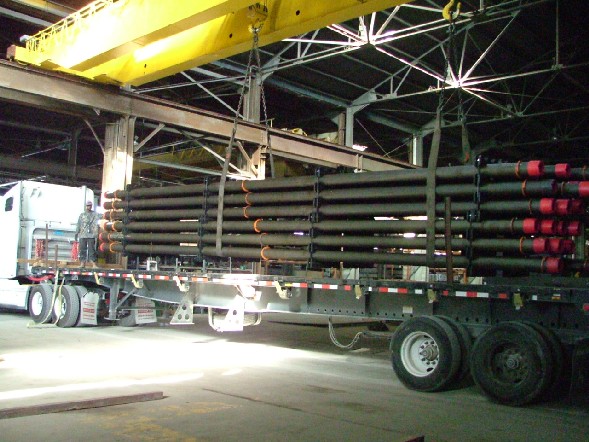
Our office works closely with the supply chain of brokers and truckers coordinating the movement of the material for our customers.
Let us help you keep your material supply moving. Just give us a call at 713-747-1101 or email us at sales@dixiecullen.com for your quotation
Tuesday, November 22, 2005
Machines headed to India!

Used Machine's bound for India
Dixie Cullen offers our clients export packing and containerizing services, specializing in used machinery and equipment.
Using Certified Heat Treated Wood, we will containerize equipment that our customers purchase.
This equipment will be loaded into the containers, spreading out the weight as necessary, blocking and securing into place so that the containerized equipment does not move or break loose during handling. We do not "just stuff" containers. Bracing is used as necessary to secure high pieces, anchoring as needed to secure movement, and covering in plactic to help protect against the elements in the open top containers.
The entire process is documented in photos, and copies of all photos are emailed to you, your broker and any other parties that you request. Contact us TODAY sales@dixiecullen.com for your personalized quotation
Additional Floor Space Added
30,000 square foot addition added to our warehouse facility
The addition of approximately 30,000 square feet to our warehouse facility permits us to easily handle the expanded services, in addition to our regular services that we offer to our clients.
We have room available for your immediate storage needs, be they intransit, short term or long term requirements.
Please contact us TODAY for your personalized quotation.
sales@dixiecullen.com www.dixiecullen.com
Ph: 713-747-1101 Fax: 713-747-1422
Thursday, October 27, 2005
Steel Handling Services Expanded
Value Added Services NOW available
for our Steel Storage Customers
Over the years we have had the opportunity to handle the steel storage and distribution for several of our customers. In recent months we have seen an increase in the number of customers using our warehouse facility to distribute to their customers. We routinely receive material that has been discharged from the ship large quanities that we unload at our warehouse facility, inspect, inventory, place into storage and release upon customers authorization.
Along with the increase in business we also noted that material sometimes comes in damaged, rusty or with torn wrappings. To help our customers facilitate their quality control for material shipped to their end customers we have started offering "cleaning" services. When our customer directs, we can remove torn plastic, fix broken bands, rebundle, clean and oil.
Contact us today with your specific needs sales@dixiecullen.com or by calling 713-747-1101
Dixie Cullen In the News:
Industry Names Top 15 Women in Gulf Transportation . .
Gulf Shipper, a publication of the Journal of Commerce recently wrote about Women excelling in the Gulf Transportation Industry and named the Top 15 Women, of which Catherine James, President of Dixie Cullen Interests Inc was among. Dixie Cullen is located close to the ever growing Port of Houston.
Subscribe to:
Posts (Atom)